

 Apple Podcasts
 Spotify
 iHeartRadio
 Podcast Addict
 Amazon Music
 Podchaser
 Castro
 Castbox
 PocketCasts
 Deezer
 PlayerFM
 Goodpods
  RSS Feed
 Is it a motorcycle if it's a cycle with a motor?
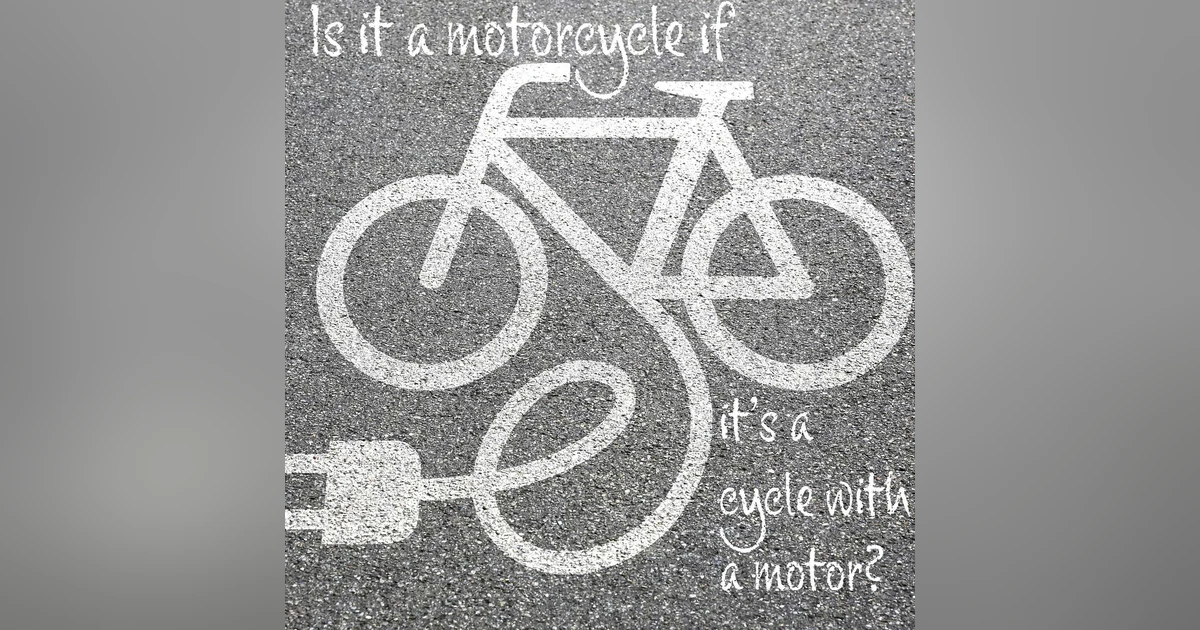
In recent years, the conversation around two-wheeled vehicles has grown increasingly complex, especially with the emergence of new categories that blur traditional lines. A motorized cycle is at the heart of this discussion, capturing the essence of a wide spectrum of vehicles now occupying the space between classic bicycles and full-fledged motorcycles. Traditionally, bicycles were simple, human-powered machines. The rider supplied all the energy, and technological advancements focused on improving mechanical efficiency, reducing weight, and borrowing select features from motorcycles, such as suspension and gearing. However, the core distinction remained: the absence of a motor.
Enter the era of the e-bike, a true cycle with a motor. E-bikes resemble traditional bicycles but integrate batteries and electric motors to assist the rider, either through pedal assistance or a throttle mechanism. This innovation has made cycling accessible to a broader range of people, allowing those with limited physical ability to enjoy longer rides and tackle challenging terrain. E-bikes are typically limited to 750 watts of power and, depending on their classification, may restrict the speed at which the motor provides assistance. With pedal assist, the experience remains close to that of a regular bicycle, while throttle-equipped models feel more akin to low-powered motorcycles.
The evolution does not stop there. The emergence of e-motos—cycles with a motor that look and ride much like lightweight dirt bikes—pushes the boundaries further. These vehicles forgo pedals entirely, rely exclusively on throttle control, and boast power outputs several times greater than e-bikes. While not generally street legal, they provide a compelling option for off-road enthusiasts, further muddying the waters between bicycle and motorcycle.
This growing spectrum of cycles with a motor has sparked controversy and debate, particularly around legal definitions, safety regulations, and permitted usage. Many jurisdictions struggle to classify these new vehicles. Should a cycle with a motor be treated as a bicycle, a motorcycle, or something entirely new? Regulations vary widely, with some trails and roadways prohibiting any motorized vehicles—including e-bikes—while others allow limited use depending on speed and power.
The core issue is that the once-clear boundary between human-powered bicycles and engine-driven motorcycles is now a wide gray area. As cycles with a motor become more common, they challenge lawmakers, cyclists, and motorcyclists alike to reconsider how we define, use, and regulate two-wheeled vehicles. Ultimately, the rise of cycles with a motor is reshaping mobility, offering new opportunities but also necessitating thoughtful discussion about safety, access, and the future of personal transportation.
Thanks for listening!
Click the "Send us a Text Message" link above to send us your questions, comments, and feedback on the show! Please make sure you leave the podcast title. Or if you prefer to leave an audio message, leave us a voicemail on our website!
Subscribe to our newsletter to keep up to date on the latest from the show.
Check out our favorite products to use on and off your motorcycle.
00:00 - Introduction
00:39 - Bicycles
04:13 - e-Bikes
08:29 - e-Motos
09:35 - Motorcycles
10:10 - Controversy
17:36 - Wrap up
Four wheels move the body, two wheels move the soul. But does it matter what kind of two wheels you ride? Welcome to the Throttle and Roast podcast. I'm your host, Niels Meersschaert. In today's episode, I'll look at four different types of two-wheeled vehicles that are blurring the lines of what we ride. We'll look at bicycles, e-bikes, e-motos and of course, traditional motorcycles and see how they differ, how they're similar and how there are confusing legal definitions around the globe. So let's start with bicycles. Now a bicycle is probably the first two-wheeled vehicle you ever rode. Probably when you were a child, you learned how to balance. You learned how to use the handlebars. This was usually for most of us, our first introduction to what riding on two wheels was. But of course, all of the basic power that we were doing to move us forward came from ourselves. We had to move those pedals around the crank in a circular motion, which moved the chain and drove that rear wheel. So there was a lot of mechanical things that were in a sense, similar to what we see in motorcycles. But it was still, we were the engine. We were the one moving it forward. And if you think of the first bike that you might have had, it might have been one of those bikes with the coaster brakes, you know, the ones where you move the pedal a little bit backwards And then that provides some braking only on the rear wheel. Of course. And how many of us did the skid out turn and we locked that rear brake up. Now, if you started to advance in your bicycle, you might've had some bikes that had both front and rear brakes actuated by levers on the handlebars. Now it starts to feel a little bit more like a motorcycle again, right? We're starting to have a different control surface that we're using to adjust. And many bikes, as you started to advance even further, may have even had multiple gears, you could shift gears to allow you to go faster and faster. And the ratio of how many rotations you'd need to do on that crank to how much the bicycle actually moved was what these gears affected. And this allowed you to be able to go really fast on a flat section or get tremendous amount of torque where you might have been rotating that crank five, six, ten times before one rotation of the wheel, just to be able to get you up that hill. mountain bikes started to borrow even further from motorcycles, adding in suspension. And these looked just like standard telescopic forks that we have on motorcycles today, but later they started adding in some of the full suspension models where we also had a rear shock. Now the geometry of these on bicycles does look very different than we're used to seeing on a lot of motorcycles. The closest approximation would probably be one where we have a linkage mechanism in the rear shock, allowing us to have a different geometry of what is affecting the movement of the trailing arm of the motorcycle, as well as the movement of the shock throughout its movement Now the big thing with bicycles is that lightness matters. The lighter the bike is, the easier it is to climb and to maintain speed because remember it's just our own body that is providing all of the power. Now high-end bikes would often have very lightweight components and these cost a lot more. they're usually made with maybe some more exotic materials. And that little bit of extra savings of weight could make the difference, especially for competition. some full suspension bicycles with very lightweight components could run as much as $10, 000. So they're very, very expensive when you consider that you are still powering yourself. So even across the entire history of bicycles, we have seen a continued movement where they're borrowing some of the elements that we have incorporated into motorcycles, be it gearing, be it suspension, etc. And that lightness is really critical as well. This is why a lot of motorcycles will try to get as light as they possibly can. Again, it allows you to have more performance for the same amount of power. Now in the past several years, we've started to see a new category of bicycles start to emerge, that's been sometimes called an Now generally, these still look like bicycles. The only difference is they may have a battery mounted onto the downtube, or it may be completely encased in the downtube making it look like a little bit of a larger downtube, and they'll have a motor on the crank. Generally speaking, these are usually limited to about 750 watts of electric power, sometimes less, but that's usually about the upper boundary that you'll see with an e-bike. the first category I'd say would be like a pedal assist. In a pedal assist, the motor in the crank is really providing additional torque as you pedal. So this can allow you to accelerate faster, it can help you climb hills that would be very hard to do just on your own, and allow you to ride longer without fatigue. These have even allowed some older riders to still ride bicycles when they didn't have the strength or the flexibility that they had when they were younger. And e-bikes are really making that possible for Now there's another version of e-bikes where they actually have a throttle just like you have on a motorcycle. You'll twist the grip and it provides power to accelerate the bicycle just as you would, but without pedaling. It's just powering the motor on its own with no effort by the rider required. Now here in the United States, we often describe some variations of these couple of different styles as different classes. So typically a class one would be pedal assist only, and it usually has a maximum speed of 20 miles an hour. Now what that maximum speed means is that the rider can go faster than 20 miles an hour, but of course they can only do that by themselves pedaling faster and the gearing that allows them to do so. The motor will no longer add any assist after 20 miles an hour. And this is just meant as a safety precaution so that it's like, hey, if you want to go faster, you can, but it has to all be from your own body providing that There's also a class type of a bicycle and this has pedal assist or throttle. Sometimes you can actually have both options on the bicycle. Still has that same limitation of a maximum speed of 20 miles an hour for either the assist or the throttle that'll be where it maxes out. And this allows you to still ride the bicycle as you want up to 20 miles an hour, but without even having to pedal. So it can be a little bit more like a motorcycle in the regard of you're still traveling along, albeit not super Now a class 3 bicycle a bike will typically have both pedal assist and throttle, but it has a maximum speed of 28 miles an hour for pedal assist, but still 20 miles an hour for the throttle. So again, gets you a little bit quicker if you wanted when you're trying to still Now, of course, different manufacturers will choose whether they have a throttle or The key thing you have to remember with the e-bikes is that the batteries and the motor add weight, and many times a significant amount of weight to being a regular bicycle. And this can make it harder for when the battery runs out, and you no longer have any pedal assist. Now you're pedaling this bicycle that weighs sometimes two to three times as much as a regular bicycle of similar capabilities would because Now, there are some people who will make the arguments that a pedal assist model can feel a little bit more like a regular bicycle, and therefore it's just giving a little bit of augmentation. It's not really a different thing. It's just kind of helping you out a little bit. It's a support structure. Whereas with throttles, these start to feel a little bit closer to a motorcycle. And this is affecting how different jurisdictions are defining these. And as I said, this is the classification that we typically see within the United States. Although even in the United States, each state has different definitions and may restrict or allow e-bikes on different surfaces. Now the next category I want to talk about is sometimes been called an e-Moto. And these look a lot less like bicycles and start to look a lot more like a dirt bike. They typically have more power than e-bikes, ranging from anywhere from three kilowatts up to 15 kilowatts, which is anywhere from four to 20 times more power than you get with a typical e-bike. These have throttle only, there are no pedals, they have foot pegs just like a normal motorcycle would have. And they'll generally be faster. They'll be able to do 30 to 60 miles an hour. They usually have a reasonably lightweight chassis when you compare it to a of less generally about 140 pounds. Very, very heavy still, if you were comparing it to a bicycle, but maybe significantly lighter than if you were to compare it to let's say like a Harley Davidson of like eight, 900 pounds. Generally speaking, these are not street legal. They are not a bicycle, they are not really a motorcycle either. They're kind of more like a dirt bike and dirt bikes in general are not street legal. of course, motorcycles is what probably most of you guys know as the kind of vehicles that we tend to enjoy. There are electric motorcycles, and these will generally have more than 20 kilowatts of power, and the top speed will generally be more than about 80 miles an hour. and be used just as a normal internal combustion engine motorcycle would be. Of course, internal combustion engines can offer extended range and faster range extension than electric. So if you go into a gas station, I can refill the tank far faster than I could recharge the battery on an electric But if we start to look at all of these, now we've had this sort of spectrum that I've just discussed going from regular bicycles to e-bikes to e-motos and now to motorcycles. had a pretty clear delineation, because these lines are not quite as clear as they once were. When it was just bicycles and motorcycles, we had a pretty clear delineation. One was human-powered and the other powered by a motor, or, and it could be an internal combustion motor, it could be an electric motor, but one was powered by a motor. With these other types of categories, that clear delineation starts to disappear. The other thing with bicycles is you could ride a bicycle and a motorcycle on the street. Bicycles didn't require licenses or registration, and you could only really go as fast as you could pedal. But when you start to get into these e-bikes, they really start to feel more like a hybrid. Is it a bicycle? Is it a low-powered motorcycle, like a moped for example? Like what is it? this is where there's a bit going on where these two-wheeled conveyances are really starting to look not very clear distinction between them and that makes it a lot harder. Now, when you look at E-Moto's of course, these really just look like dirt bikes, and in many ways, practically, they are dirt bikes. They just happen to be powered by electricity as opposed to an internal combustion engine. we now have this continuum ranging from human-powered bicycles to engine-powered two-wheeled vehicles. But various options that are in between there really start to create all these shades of gray, and this is making it a little bit more challenging. So how do we categorize them to fit when these differences aren't as clear as they were before? Do I define this still as a bicycle, or is it a motorcycle? It has a motor, it is a cycle, so is it a motorcycle or is it still a bicycle? Like this is where this gets a little difficult for a lot of to just consider. In most jurisdictions, a motorcycle has to meet certain requirements of the government. It has to have certain equipment. This might be including indicator lights. It might include headlights, taillights, brake lights. It may include a horn. All of these other considerations that are required as basic capabilities of the motorcycle to be able to be used on the street. Well, do we need that also for e-bikes? And this is where this starts to feel a little challenging. Now, some people are using e-bikes and e-motos on the street and maybe e-motos are a little bit more controversial than an e-bike. And the question is, should they be registered? Should they require licenses like motorcycles? Like this is, they're not really as clear as a pure human powered bicycle, but are they also a full motorcycle or are they something different? Are they something in between? Now, another one that we're seeing that is becoming problematic, and I see this in my local area as well, is can you ride an e-bike or an e-moto on the same bike trails bicycles can go on. So as an example, we have all these uh what used to be railway lines have now been converted into effectively trails that people can walk and cycle along. Well, some of them don't you allow you to use an e-bike. Even though it's a pedal assist only, but the thought is that if it has a motor of any kind, you can't. And many of them will say no motorized vehicles. So does that include an e-bike? You see where this starts to get a little bit cloudy of what the definition is and what the intention is. But if I can't use an e-bike on the bicycle only trails and I can't use an e-bike on public roads because I don't have a license or registration, where can I use it? It's the it's in this limbo land that makes it really really hard for where I can and even if you were to go on to some trails for example mountain bike trails Some of them won't even allow you to use an e-bike on those mountain bike trails because they feel that it will have perhaps a little bit heavier erosion on to the trail or the speeds may be too fast and therefore it's more likely to cause injuries with other riders. So what do we do I mean a lot of people will use bicycles for commuting especially if you don't have a long way to go a bicycle is actually a very efficient mechanism for you to get by and an e-bike makes it even more so you can have an e-bike that For example acts more like a cargo bike where you can carry your groceries onto it. It makes it really really effective but if I can't use that on public roads I can't really go to where I need to commute if I can't use it on On the bicycle trails or the bike lanes. I can't use it for what I want to do now there also have been some we'll call them bad apples that have been causing some issues including injuring pedestrians while they're riding these bikes and From the non riding public's perspective They're oftentimes being grouped in with motorcyclists, and I think this is why I wanted to kind of cover this in this episode is Sometimes that is then causing them to say hey well these two-wheeled you know Motorized vehicles they're just problematic no matter what and we should just get rid of them and this is why I think having this Unclear delineation amongst these vehicles of two-wheeled conveyances matters for us as motorcyclists because we can be affected by the rules that affect them and they also can be affected by the rules that affect us so Where do we kind of come together with this various? Vehicles and how it impacts us and I think this is the real open-ended question I don't have a particular answer for it. I think it's Much harder than it was Maybe you might say an e-bike which has pedal assist only you'd think of distinctly from any of the electric Bikes or motos that have a throttle and maybe that's a reasonable Delineation, but if I could still have An e-bike that's providing pedal assist up to 28 miles an hour I can get going at a pretty good clip and most cyclists Maybe they're wearing a helmet Well, I can tell you if you fall off of the bike and you scrape along the pavement at 28 miles an hour, it's still gonna hurt. You're gonna lose a lot of skin on that and it's not gonna be a comfortable situation. Whereas if you were pedaling just on your own, maybe you got 10 miles an hour, maybe 15. That's a much slower speed. It's not gonna have the same impact onto you from an injury perspective. So cyclists gonna suddenly wear the same protective gear that we as motorcycles? Are they gonna wear a full bike and a full armor-plated jacket and pants? Are they gonna wear a full big helmet, gloves, et cetera? I don't know, this is why I think this is such an open-ended controversy that's going on right now. So let's wrap up. We looked at what a regular bicycle is, how it differs from an e-bike, and then e-motos which start to look a lot more like dirt bikes than bicycles, And finally, motorcycles. And then we looked at some of the controversy that's going on right now about e-bikes and e-motos. It's clear they aren't the same thing as bicycles, but are they the same as a Should they be regulated like motorcycles? And if so, how Or are they in no man's land where they can't be used as a bicycle or a motorcycle? And are they having an impact on regulations about motorcycles as well because that unclear situation is going on? So my question for you this week is, what do you think about e-bikes and e-motos? Are they just another bicycle option? Or are they starting to encroach on motorcycles? Share your thoughts through the text to show link in the show notes or leave a voicemail at throttleandroast.com slash voicemail. Thanks for listening. I'll talk to you next week.
