

 Apple Podcasts
 Spotify
 iHeartRadio
 Podcast Addict
 Amazon Music
 Podchaser
 Castro
 Castbox
 PocketCasts
 Deezer
 PlayerFM
 Goodpods
  RSS Feed
 Hanging out on your next motorcycle trip
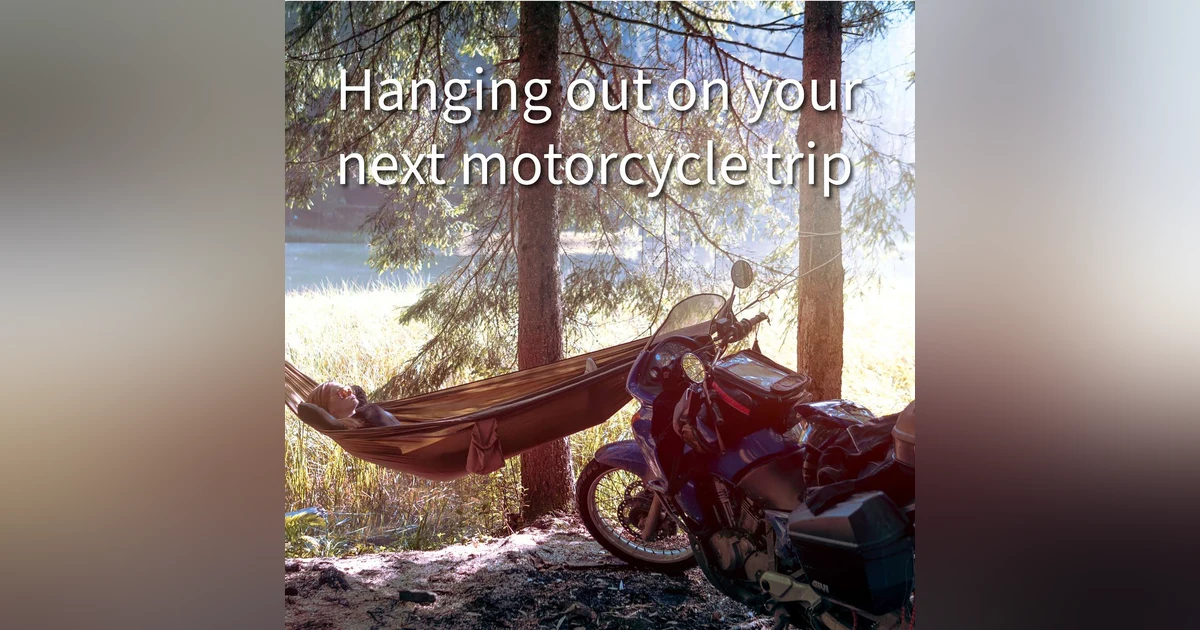
In this episode of the Throttle and Roast Podcast, host Niels Meersschaert explores the unique joys and challenges of hammock camping while motorcycle touring. The episode begins with a discussion on why moto camping stands out compared to traditional travel. When you’re on a motorcycle, you’re deeply connected with the elements, experiencing nature in its rawest form. Camping continues that experience, offering not just the thrill of travel but also the freedom from expensive hotels and a deeper sense of adventure.
The heart of the episode is a deep dive into hammock camping, perfect for riders looking for minimalist, efficient, and comfortable ways to rest after a long day’s ride. Niels points out that hammocks are incredibly compact, saving precious space on your bike, and they eliminate the need for a chair by doubling as a relaxing seat. This makes "hanging out" by your campfire literal, as your hammock becomes a central part of both your relaxation and sleep setup.
He highlights that hammocks don’t require flat ground, making it easier to set up camp in unconventional spots—no need to clear rocks or worry about water pooling under your tent. Plus, being off the ground keeps you away from bugs and critters. Niels shares personal anecdotes about showing fellow campers how to lay flat in a camping hammock (not the usual banana shape) and how comfortable it can be, sometimes even more so than a bed at home.
However, he doesn’t shy away from the limitations. Hammocks require trees or sturdy posts at the right distance, sometimes forcing creative solutions like using fences or portable stands. Gear storage can also be a challenge, but Niels recommends gear slings that hang beneath your hammock to keep belongings dry and safe. Despite these hurdles, the episode concludes by encouraging listeners to try hammock camping for themselves, emphasizing that with the right setup, “hanging out” while moto camping can be one of the most rewarding parts of the adventure.
Thanks for listening!
Click the "Send us a Text Message" link above to send us your questions, comments, and feedback on the show! Please make sure you leave the podcast title. Or if you prefer to leave an audio message, leave us a voicemail on our website!
Subscribe to our newsletter to keep up to date on the latest from the show.
Check out our favorite products to use on and off your motorcycle.
00:00 - Introduction
00:46 - Why motocamping is awesome
07:38 - Hammock Benefits
13:55 - Hammock Limitations
17:25 - Workarounds
23:20 - Wrap up
When you're scared, when you're hanging on, when life is hurting you, that's when you're going to see what you're really made of. Welcome to the Throttle and Roast Podcast. I'm your host, Niels Meersschaert. In today's episode, I'll be looking at camping with a hammock on a motorcycle trip. Now I just wrapped up the BMW MOA rally in Vermont, and I brought a hammock for the four days that I was on site. I'll share an overview of why camping with your motorcycle is awesome, the benefits of a hammock over a tent, some of the limitations that you might find with hammocks, and even some workarounds for those limitations. So let's get started with why I think moto camping is awesome. The biggest thing is when we're out on a motorcycle, we are out and exposed in the elements. That's part of the big appeal, at least to me of being on the bike is you experience the environment in its totality. So when you get out and you're camping after you've done a ride on the motorcycle, it's that same experience. You're still continuing to be out in nature and really enjoying all of the experience and totality that comes in. If it's cold, you're cold. If it's raining, you're wet, right? And this is why I think it, it just sort of continues that feeling that rawness that we have in motorcycling. Now, another big benefit to camping, as opposed to going into a hotel is that you don't need to find a hotel. You can camp just about anywhere. Now, while a lot of riders will choose to go to an established campground, that doesn't mean that you must use an established campground. There's plenty of places where you can just pull set up camp, and you're good to go. one other thing that I'd say is related to that of being a lack of having to use a hotel is just your expenses. If you want to go on a trip on your motorcycle, having a camping setup as opposed to a hotel can save a tremendous amount of money. Now, you do need to buy the camping equipment, so I'm not going to sugarcoat that and ignore it. But on a per-use every time that you go to a hotel or a motel, you're spending, what? $60, $70, $100,$200 a night just to be able to stay there. It's significantly more expensive. Whereas, if you are at a non-established campground, it's free. Even if you go to an established campground, most of the fees per night are $10, maybe $20 a night. So, it's a very minuscule amount. this can save you a lot. It allows you to travel far more often than you would able to do so otherwise, if you had to pay hotel fees every single the other thing I'd say is that riding with a motorcycle isn't necessarily about modern comfort. If you want to be comfortable, you're probably going to get into a car and then you'll have no problems whatsoever. You've got the AC, you've got comfortable seats. No one's going to get really exhausted doing a long road trip in a car. Whereas on a motorcycle, that's part of the experience. It's a bit of a fight with your own experience of how do we overcome the challenges. And camping can sort of enable you to just continue with that experience of you're really trying to overcome nature. You're trying to be part something that's not easy. Something that takes more effort. And the effort is what helps you grow and really can be in its own reward in many ways. And as part of this, this is why in a sense, it's, it's about reconnecting with our primordial selves. It's about getting back to the basics of humanity and of nature. And you don't have that if you're just going into a hotel or certainly not into like a four or five star hotel, you're not anything into your selves. And what I love about motorcycling is that it is that. It is this raw essence that you have. And so camping, I think in many ways, just continues that experience. And of course, with the right gear and attitude, it doesn't have to be uncomfortable. And when we think of this, there are just so many options for how you can choose to camp on a motorcycle. But you can use some of the backpacking tents that are widely available and those tend to be fairly lightweight. So they're not going to take a lot of heavy load onto your motorcycle. Most bikes can very easily carry those in luggage, or if you strap it across rack or across the pillion seat, if you're riding solo, it's pretty straightforward and easy to do. The other kind of tent that you can use. And this is one that's sort of evolved. I'd say in the past several years is you can get a bike specific tent. Now these are really, I think the intention was to use them for cyclists who are riding their bicycles on long trips and they needed something that was relatively compact. They'll typically put it right in front of the front handlebar. And therefore the poles are much shorter, but this works out really well for us as many as we can. motorcyclists, because our panniers tend not to be quite as long as a traditional backpacking tents poles will be. But these bike packing tents, they can work really easily and you can fit them into the panniers. And of course tents that are really intended specifically for motorcycles. One great example of that is the Redverz. I think the current model now is called the Atacama. what's great about that set of tents is, A, you have an enormous sleep space. It's basically large enough to fit a queen size mattress. And you have this huge garage. You can actually park your motorcycle under the tent. It's fully covered and protected from elements. And then you even have a little space to the side where you can sit down and just be fully covered sitting next to the bike and just enjoy it just as a hangout spot. So these motorcycle specific tents can really give you a much more of a base of operations in a sense. It's almost like having a suite instead of a small little tent. And it can become a really cool option for you if that's what you want. And I do own one of those Redverz tents. They're a phenomenal tent. if you are going on a longer trip where you're going to be sitting at a base of operations for a number of days, I think they're a phenomenal option because it gives you a lot of ease of use for that time. Of course, there's other options. These sort of all-in-one options or swag like the ones from Wingman on the Road. Now, this tent in particular, I happen to have a Toucan from them. And what's cool about it is it's a canvas tent and it has the mattress already put inside of the tent. And it even has the sleeping bag already inside of the tent. So I can go from it being mounted on my bike to set up and I'm lying down in there fully ready to go in about five minutes. They're super, super quick to set up. They're bulky, but they look really awesome and retro, especially if you're riding like a cruiser or an old-style motorcycle. And of course, the last option that you have for using for camping is hammocks. And that's what we're going to talk about in this episode, because it's one that probably is less familiar or less common amongst anyone who's even just gone regular camping. If you're going out with your family, you go hiking and backpack camping. There are people who do use hammocks, but it's not quite as common or prevalent as a regular tent would be. So let's go into why I think hammocks for motorcycling is a really interesting option. I'm going to start with a few of the benefits first. So the biggest benefit to me is actually the pack size. Now the pack size of a tent is usually defined by the length of the poles. And this is usually what makes it challenging for motorcyclists as many tents won't fit in their panniers. And that's why those bike specific tents that have the shorter segments work. Now those do have shorter pole segments, but because there's more segments, the tent pack space is actually a little bit wider. So it's not really changing it. It's just changing where the dimensions fit. But with hammocks, you don't have poles, which makes them incredibly easy to pack. And if you're camping by trees, a pair of tree straps, the hammock is enough. And the big thing with a hammock is its pack volume, because it doesn't have all of these poles and other elements to contribute to its bulk, tends to be as little as a third or even a quarter of the volume of a camping tent that one would use. And what I'm referring to here is I'm saying, like, if you think of something like a two-person tent, which is pretty much, that's a good size tent to use for a single person when you're camping. Usually go up by one person in terms of the size. So it's a little bit more comfortable to fit in. But if you compare those, you'll find that it's generally about a third to even as little as a quarter of the size in volume. Now, if you need to add in a tarp in case you're gonna have any sort of rain, those again are really tiny and they can fit into nearly any bag. I actually did a multi-day trip on a sports bike using three of my Kriega dry bags mounted on the pillion seat and hanging on the sides, and that allowed me to fit my complete hammock with tarp set up, all my cook gear, toiletries, camp clothes, everything fitting into those tiny little bags. It was super easy to do. And if I was using a traditional tent, there's no way that would have fit into those bags because just the poles would never have fit into them. They were way too long. And even one of those bike specific tents, the bags were still too small for those type of tents to fit into them. So there is real benefits when it comes to pack size when you look at hammocks. The other thing I'd say is for hammocks is that they have an opportunity to provide double duty. When you camping, and especially as a motorcyclist, you may often bring a chair with you so you have somewhere to sit around your campsite. Well, your hammock does double duty as a seat, so you don't need to bring a chair, which saves you even more space. So if we think if we're already at a quarter or a third the size when it comes to pack size for the hammock versus the tent, well, then I also don't need a chair. You really can be quite frugal when it comes to pack size if you use a hammock as opposed to a traditional tent. now there's some other benefits for hammocks, and I'd say the first one is flat ground is not needed. Generally, when we go out to pick a spot for a tent, we look for something flat, no roots, no rocks. So we have a comfortable spot to put our tent down, and thus our sleeping bag, because it's going to be directly on top of that. But a hammock doesn't have that sort of an issue. Since you're hanging above the ground, it doesn't matter if there are roots or rocks. You can even hang over a slope or other areas you'd never consider placing a tent. Think of like a gravel pit. You could easily hang a hammock over that, whereas you would never do that with a traditional tent. favorite for camping is to basically find some trees right along a river's edge. You get that nice cool breeze right from the water. You've got a beautiful sound. And when you wake up in the morning, you can just look out and you see this river going right by you. It's an amazing experience and one that I think is outstanding. Now, related to that, when we start to think about water, this is another big thing that you don't have to concern yourself with quite as much with a hammock as with a tent. When you're thinking about where you're going to put a tent, if it's got a depression underneath where the tent would be, well, that can pool water. So if it's going to rain and you're worried about that, you don't want to have where the tent is just sitting in a puddle. Whereas with a hammock, because you're elevated, it's not really a concern. Yeah, you might have to swing your legs out into the puddle, but you're not worried about it soaking into the tent and then possibly leaking through the waterproof bit of the tent, because that's meant for sort of drops, not necessarily standing water. The other big thing is any sort of creepy crawlers, any insects, etc. They're not going to be crawling around into your tent because your hammock is elevated a couple of feet above the ground. Now, the last big benefit to me with a hammock actually comes down to comfort. Now many people have backyard hammocks that they use for relaxing and they might all too often fall asleep with the gentle rocking of the hammock and the breeze. And it's some throwback, maybe, to when we were in the womb and we were floating around. But the thing is, sometimes people will say, but it's not comfortable for me to sleep in a hammock that's out of my backyard. And it's because they're thinking of it in a, they're sleeping along the curvature of the hammock. And so they kind of are bent like a banana The thing is, camping hammocks are designed a little bit differently than normal hammocks. There's usually a little bit of extra fabric to allow you to swing sideways to lay totally flat instead of that banana shape. Now, actually, when I was at the BMW MOA Rally, I actually had a number of people come over and they were surprised that I was sleeping in a hammock and that it could be comfortable. They were like, "I love my hammock for just relaxing, but I could never sleep in it, it would be totally uncomfortable." And then when I showed them that, "No, you actually just lay down and you just rotate a little to the side." Their eyes just lit up, they were like, "I had no idea that you could do that." So you get all the benefits that you'd have of just that gentle breeze and swinging, but you're still sleeping on a relatively flat surface. And in fact, I personally find it sometimes more comfortable than my bed at home to be in a camping hammock. So with all these pluses, you might be wondering, well, why isn't everyone just switching to hammocks instead of using a tent? Well, it's gonna have some throwbacks and everything in life is always a trade-off and hammocks are no different in that regard. You need to make sure that you have trees at the right distance from one another. And this is usually the biggest limitation because you need to be able to hang your hammock between the two trees. And while the straps can offer some adjustment for some variance in the, in the distance between them, it won't work with trees that are 30 feet apart, nor ones that are three feet apart. You need to have kind of in a, in a relative sweet spot of range of the trees being apart from one another so you can get that proper hang between them. Now, sometimes you can use a fence in a pinch. So maybe you have a single tree, but then there's a fence that's close by. And what you could do is you could strap one end of the hammock to the tree and the other end to the fence. And I even a few riders were using that at the rally using some of the corner gates so that they could use the spacing between those two sides of the fence line to offer an ability for them lay their hammock between those two fence So you can do it in a pinch if you have at least two elevated objects that are close to one another. They don't necessarily need to be trees. The other big thing and I'd say is especially in like national parks, some places may not allow you to hang a hammock from a tree because they're worried about if you don't use a, a proper tree strap, you can actually damage the bark on the tree. And so some of them just forbid it because they don't assume that anyone will bring a proper strap. So this can make a real limitation for you to be able to use a hammock in more places. And of we're talking about places where they have trees. Well, there's plenty of places on the planet where trees aren't really ever there. Like if you go into the desert, there's nothing to hang from. What are you going to do? Hang from a cactus? It's just not a realistic scenario for you. And you're not going to find two cactus right next to one another. And it's probably going to cut through everything. It's not going to be very comfortable to wrap around it. So deserts tend not to be a good option for hammocks. Likewise, open fields are usually not also a good option hammocks. And the irony is that's what most of the stuff is at a rally like the BMW MOA rally. All the camping areas are wide open spaces. So you'd sit there and you say, well, then there's no way to really use a hammock. And that's why people were using some of the fences. They were, they were cornered off to the side. And I saw a couple of other hammocks that were at the rally, and that's how they were setting themselves up. Another limitation, and this is why I think a lot of people will tend to go a size up. So if they're going by themselves, they'll get a minimum of a two person tent. So they have a little bit of gear storage inside of the tent. So it's actually protected from the elements. It's protected from anything getting into there. And that's not really an option in most hammocks, because the hammock is really just big enough for you to lie in, not really having a lot of space for other things. Now, my hammock that I use has a little gear shelf on it so you can keep like your phone and a few other items, your bike keys, a magazine, whatever, but it's not going to hold your helmet or a riding gear. And that is a really very small area. And so these limitations that one has for using a hammock for camping are real. And this doesn't apply just only to motorcycles, but it applies to anyone who's using hammocks. And that's why they're probably not as popular as others. But there are some workarounds, and I'm going to go through a few of those because I actually used one of these workarounds at the MOA rally. And that was the thing that I think for a lot of people, even some of the other hammock people who came over and looked at it, they were really asking about this, because it's an unusual setup and allows you to use your hammock in many of these areas that we said you just don't have the option. So the first one is a hammock stand. Now these offer a way for you to bring your hammock out to places where you wouldn't normally have the option. So while many stands are meant for home use, and I have one of them here at home, I've got one of those Eno stands. It's not really a portable stand. It's pretty heavy. It's just meant to be always outside. And we can just string our hammock up when we want to lay in the backyard and just relax. Now, there are some camping stands will break into sections just like a tent pole. However, since they need to support your weight and not just a bit of tent fabric, they're much thicker and heavier. Now knowing that MOA rallies tend to have a lot of open I ended up bringing my YoboGear Turtlebug Camper hammock stand. And this is one of the more bargain models at about $400, which sounds like a lot. You think of, hey, well, a good tent probably costs $400. Why am I just buying a But the big thing is that when you're looking at something that you don't need all the time, but it has to be strong, it has to be robust, it's going to cost a little bit more. And this is also from a small artisanal maker. not going to have the same economies of scale that you're going to have with a massive tent manufacturer, where they can get the price down a little bit lower. So you are paying a little bit for that. But I will caution, it is not light. It is 17 pounds. It's not something you're going to use for backpack camping. Now it does come in its own bag, but this bag is kind of like a mini duffel bag, but it's not something that I would just mount directly onto the bike because I do want to protect it from the elements. So I put this inside of a waterproof duffel that I had mounted onto the rear rack of my GS. Now this brand YoboGear also makes a stand called the Cricket, which is about half the weight, but twice the price. And it's also available in an ultralight version, which is about three pounds lighter than the Cricket, but it has a 200 pound weight limit. the biggest problem I'd say with a hammock stand is that I lose the pack size advantage with the stand. I've now got something that is substantially heavier, substantially bulkier than I would have had even with just a regular tent. But I have a very robust platform for hanging my hammock and it is a workaround that I like to use. Now, if you do, if you're willing to spend a little bit more and you want something even lighter, I'd take a look at the Cricket. It's about half the weight. It's going to be also a little bit of a smaller pack So there is a trade-off. But given that I'm not backpacking with it, this was purely for motorcycle use. I'm okay with being a little bit bulkier and a little bit heavier. The second workaround that I'd say is actually using a gear hammock and gear storage can still be an issue when you're using a hammock, especially as a motorcyclist. We've got our riding gear. We're going to get that off after we complete our ride. And where do we put it? Where do we put it such that it's protected in case the elements and it starts to rain or whatnot? Well, this is a reason why so many riders will store their gear inside their tent with them is just to keep the bugs and the rain and everything away. Now, my solution is to use a gear hammock and I use one made by Eagle Nest Outfitters or Eno and they call it the underbelly gear sling. I'll put a link to it in the show notes. Now this is effectively, it's like a second hammock that lies underneath my main hammock. And I can keep my riding gear, my helmet, and other items secured off of the ground. But under my hammock so that they're protected if it rains and, of course, my hammock is blocking some of the rain that might come down. And then I have a tarp on top of it, well basically protect even further against the rain. Now, during the MOA rally, we actually had a huge rainstorm right in the middle on Friday evening. It was really torrential downpour coming down. And I went and checked on my hammock a little bit later in the evening after it had stopped raining. And all my gear was completely fine and dry. No problems whatsoever. So my gear hammock really did what it needed to do. So these are a couple of workarounds that you can use if you want to do hammock camping. And I will caution. I will say, like, for example, the YoboGear Turtle Bug that I'm using combined with the hammock, it is going to be bulkier than just a regular two-person tent would be if I think of the total pack size. But for me, the advantages of I can basically set up anywhere. It doesn't matter if I'm on a slope. It doesn't matter if I have roots underneath me. It doesn't matter that I have to worry about even water pooling. All these advantages to me, plus the comfort, make it worthwhile to me as an option to bring. And it's really not that big a deal just to throw stand into your bag as you're going onto your trip. So I really like these as options and the workarounds. I think do solve any of the main issues that someone will have of they may have held off on doing a hammock. And I would encourage you to try it out. If nothing else, just get like one of those relatively cheap, ENO, hammocks just to try at home. They do make some camping versions. And the other big thing I'd say with the camping version and this is, I think where some people get confused. They'll think, oh, it's the same open hammock that I have for the ones that I use at home. Well, no, a camping hammock actually has a mesh covering over it, just like your tent would be. So it's going to protect you from the bugs and everything getting in. And you zip in and out just like you would normally do. So you're not just sitting fully exposed into nature. You have the mesh and the bug screen all around you as well. So they're really, really comfortable. So let's wrap up. I started with why I think moto camping in general is awesome. I talked about some of the other options that are out there, be it backpacking tents, bike specific tents, motorcycle specific tents, like the Redverz, or even some of those all in one options, like the ones from Wingman on the Road. And then we went into hammocks. So we talked about some of the benefits that you'll get from them from pack size to doing double duty. You don't need an extra chair. You don't have to really worry yourself about whether that's flat ground or not. And there are some of the most comfortable places to sleep that you can possibly do when you're camping. That's really one of the beautiful things about it. But there are also some limitations. You have to make sure you have trees that are at the right distance. They're not going to work for you in a desert. They're not going to work in an open field. You don't have gear storage, but there's ways to work around a couple of those. So a hammock stand will actually address many of the desert or open fields or lack of trees issue. And a gear hammock that you just put under addresses the gear storage. while there are limitations out of the box, I think there are ways to work around it just based on what your budget and where you're going to go. Now, if you're going on a trip like I did for where I knew the places I was going to be camping had trees, I didn't need to bring a hammock stand with me. So they do work in a lot of cases, just not in all cases. So my question for you is, have you ever tried moto hammocking and do you prefer it over tents? And if you haven't tried it, what's been holding your back? Share your thoughts through the text to show link in the show notes or leave a voicemail at throttle and roast dot com slash voicemail. Thanks for listening. I'll talk to you next week.
