

 Apple Podcasts
 Spotify
 iHeartRadio
 Podcast Addict
 Amazon Music
 Podchaser
 Castro
 Castbox
 PocketCasts
 Deezer
 PlayerFM
 Goodpods
  RSS Feed
 Ducati at 100: A Century of Innovation, Racing, and Style
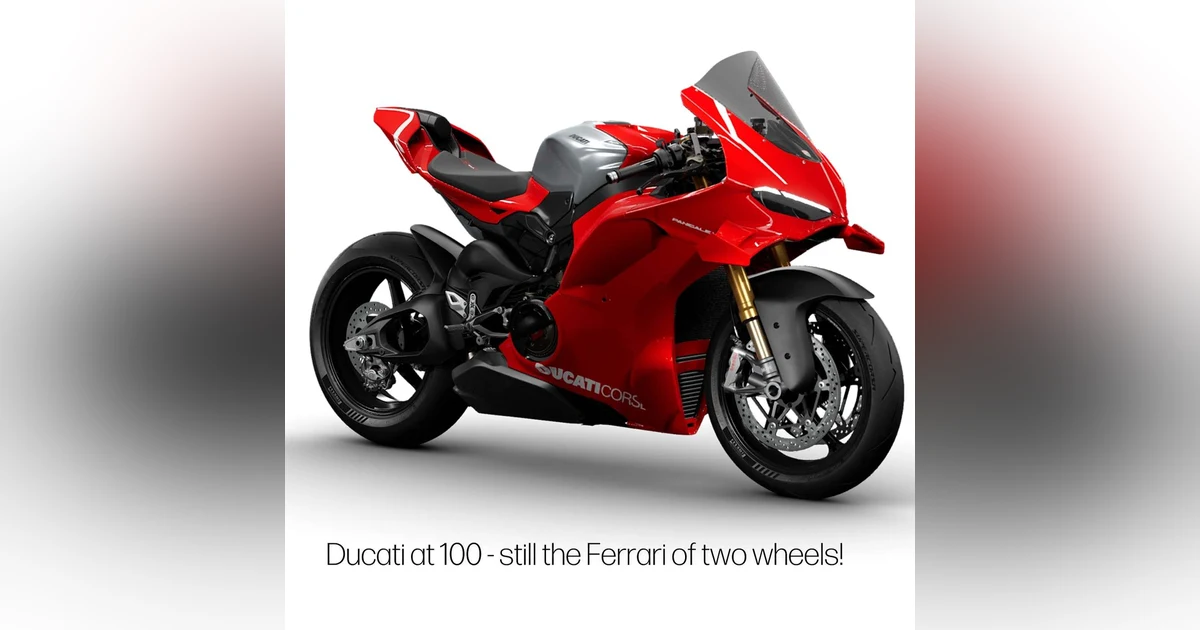
Ducati at 100 marks a significant milestone in the world of motorcycling, celebrating a century of innovation, racing heritage, and Italian design excellence. Founded in 1926, Ducati’s origins were far removed from the gleaming motorcycles we know today. The company began as a manufacturer of radios and electronic components, thriving in a period marked by rapid technological advancement. However, the devastation of World War II forced Ducati to pivot, and in the post-war era, the company transitioned into the mobility sector, producing its first micro-motor for bicycles, the Cucciolo, in 1946. This move set Ducati on a path to becoming a legend in the motorcycle industry.
The decades that followed saw Ducati embrace the spirit of racing and technological advancement. The 1960s through the 1980s are widely considered the heyday of motorcycling, and Ducati was at the forefront with iconic models like the Scrambler 450, 750 GT, and 750 Super Sport Desmo. The company’s reputation for performance and style grew, cemented by legendary wins at events such as the Imola 200 and the Tourist Trophy. By the end of the millennium, Ducati motorcycles had become symbols of status and passion, with models like the Monster and the 916 capturing the imaginations of riders worldwide.
Entering the 21st century, Ducati continued to push boundaries both on the track and on the street. The brand maintained its racing pedigree while expanding its lineup to include advanced sport bikes and adventure models like the Multistrada and the Scrambler Icon. The acquisition by Audi brought new resources, enabling Ducati to improve reliability and broaden its appeal with more accessible and versatile machines. Notably, recent models such as the 2026 Desert X and the limited-edition Formula 73 reflect a blend of tradition and innovation, with improved maintenance intervals and nods to Ducati’s storied past.
As Ducati at 100 is celebrated, the brand stands as a testament to resilience, adaptation, and the enduring allure of Italian motorcycling. Its journey from humble electronics maker to global motorcycle icon is a story of passion, evolution, and relentless pursuit of excellence.
Thanks for listening!
Click the "Send us a Text Message" link above to send us your questions, comments, and feedback on the show! Please make sure you leave the podcast title. Or if you prefer to leave an audio message, leave us a voicemail on our website!
Subscribe to our newsletter to keep up to date on the latest from the show.
Check out our favorite products to use on and off your motorcycle.
00:00 - Introduction
00:40 - What's the frequency, Kenneth?
01:51 - Post war
02:43 - Heyday of motorcycling
04:05 - End of the millenium
06:24 - A new millenium
07:29 - Ducaudi? Audi buys Ducati
09:22 - 2026 updates
12:49 - Wrap up
Ducati is the Ferrari of the two-wheel world. Welcome to the Throttle and Roast podcast. I'm your host, Niels Meersschaert. In today's episode, I'll be looking at a century of Ducati. That's right. Ducati has been around for a hundred years this July. I'll look at the early beginnings, how they emerged from World War II, and some of the super bikes that became the envy of riders everywhere. Today, Ducati has a broad model range under Audi ownership, and it still is the Ferrari of the two-wheel world. So if we go back to the beginnings for Ducati, this was in 1926. And if we think of what was happening, especially in Italy at the time, Marconi had just invented the wireless, this was a time of innovation that was going on, certainly when it came to electronics and electricity of any sort. and Ducati actually got their start with radios. In fact, a shortwave transmitter was patented by Adriano Cavallari he and his brothers formed a radio company on July 4th, 1926. And within 10 years, they had thousands of employees. They were producing all of these small radio and other electrical and electronic components But if you start to think of what happened after all this time, now it's into the thirties, well what's happening in Europe in the late thirties? Well, World War II started to emerge and of course, this made the factory a target and it was destroyed on October 12th, 1944. the economic reconstruction was really starting to become a new technology. So, this era of Ducati was really focused on electronics and radio up until the war. Now, following the war, of course, there was a lot economic reconstruction happening and the boom from that reconstruction was really starting to enhance lives in Italy and throughout much of one of the things that started to emerge as a growing trend there was about mobility, people needed to have an economical way to get around, to be able to get to their jobs, whatever they needed to do. And the Ducati Cucciolo was the first fitting of a micro-motor to a bicycle and this was their first sort of foray into they moved out of doing the electronics and really said, Hey, well, let's focus on mobility. let's focus on mobility. And that was the beginning. Now, of course, whenever you have an engine, you have racing and Ducati kept growing with up to a 250 CC GP Desmo engine in that post-war era. Well, let's talk about that now of course coming out of the post-immediate post-World War II era, we really started to get into what probably is thought of as the heyday of motorcycles, which would be sort of the 60s to 80s. widespread cars had made bikes become more of a personal expression rather than a practical transportation. So speeds increased engine sizes increased. It was no longer about being super efficient, like a moped or a very small. Powered bicycle essentially to be able to get around people wanted that speed. And in fact, Paul Smart won the Imola 200 in 1972 aboard a Ducati, Mike Halewood, of course, won the 1978 tourist trophy aboard a Ducati. And this led to an era of a whole bunch of bikes that are probably thought of as being quite iconic when we look back at them today. You may think of Ducati today and say, hey, well, they have the Scrambler line. It's not the first time that Ducati has had a Scrambler. In fact, in that era of the 60s to 80s, we had the Scrambler 450. We had the 750 GT, the 750 Super Sport Desmo, and of course, the 500 Pantah. And this really was an era of innovation of really pushing the envelope. And Ducatis were really becoming this sports motorcycle. It really was essence that they really focused on to. Now, by the end of the millennium, the Internet, of course, was beginning to surge. So, this made motorcycles become a bit more of a premium product. It was really continuing to push past that economical transportation usage that had been a lot of what people saw them for in Europe and in North America, and had emerged into more of a premium or a leisure sort of product. And by the end of the millennium, it was becoming even more so. People were spending a lot of their time online and less outside. So the fewer motorcyclists were really kind of demanding a very high premium product. And Ducati was one of the most premium products that you could buy. In fact, a lot of people thought of a Ducati as a status symbol. So if you said, Oh, well, what kind of bike do you have? And you said, Oh, I have a Ducati. People looked at you a little differently. And we had some incredibly iconic bikes. And if I think back to when I first started riding, which was at the tail end of the millennium, the iconic bikes that I thought of at that time really were the bikes that came from Ducati. When I took my motorcycle safety foundation course to get the waiver for my license, my instructor actually had a Ducati monster. And this is such an iconic bike today. That trellis frame was just such a big part of motorcycles of that era. And of course, you can think of the monster as almost a stripped down 916, which is another iconic design. Beautiful, beautiful, bike. And I remember when I first heard my, the first Ducati I ever heard in that late nineties era. I just thought to myself, that is the voice of God. It was such a beautiful sound of that engine. And of course, if you've never heard bike from that era from the dry clutch also adds a character and a sound that is distinct. And even today, if you hear that, you're like, Oh, that's probably a Ducati just by sound. This is when you're like, Oh, that's really great. No. This is when you know, you have something that is truly, truly iconic. Now, of course, the old adage says race on Sunday and sell on Monday. And Ducati was no different from that. They won their first super bike title in 1990, followed by 1991, 1992, and of course, several other wins going forward. As we move into the new millennium, Ducati still leads in racing. They still are one of the top tier manufacturers in world super They are thought of as being an absolute powerhouse when it comes to being on the track. But of course, they also bring a lot of that technology to the street. You have bikes like the 1098 or the 1199 super legera. The Multistrada 1200, probably one of the most well known bikes and especially building on top of the desire that a lot of people have. This is an outstanding bike, especially if you like the look of an ADV, but you have no intention of taking it off road. Most of the Multistradas are actually amazing road bikes. They still have that sporty DNA. So they're kind of more of like a sport bike on And of course, the Scrambler, the Scrambler icon and a whole bunch of Scrambler line, which they've actually spun off into their own brand at this point. This is almost a reincarnation of that original Scrambler 450 from way back when. And you still see it today. But as with many companies that are around today, Ducati started to feel the need that they had to have a deeper pocket. It's harder to compete as a business in a world where your number of riders and the number of potential buying public is shrinking or at least is smaller than it was back in the 60s, 70s and 80s. And this led to them being purchased by the Volkswagen Group and specifically by Audi. So now sometimes people refer to it as Ducaudi because Ducati is matched with Audi. Now, this Ducaudi sort of setup has really actually given them deeper pockets to continue to innovate. It's allowed them to maybe shed some of the, how shall we say, maybe maintenance issues that Ducati's were famous for of being a little finicky. Outstanding performance, but a little finicky. They didn't have the reliability that one would hope for. And this really started to change. The other big thing I'd say with this is they really doubled down on the adventure world. And you really got these dirty Ducatis. You know, the Scrambler had been a throwback to an earlier model and suggested off-road. The Multistrata was generally an ADV-styled road bike with a huge performance window, but Ducatis really started to get a little bit more dirty with their bikes, offering more off-road-oriented Multistrata models. And of course, now the Desert X, which is an outstanding model from Ducati. It's not going to be quite as competitive as a KTM. I think it looks outstanding though, but it's close enough for the vast majority of riders that it gets you a little bit more off-road capability while still looking outstanding and still having that Ducati DNA. Now, the 2026 Ducati Desert X uses the V2 engine that has been used in many of the other models and its power matches what the outgoing model had, but valve checks are now at 28,000 miles with regular service at 9,000 miles. So no more Desmo service nightmare. And this was, I think, the biggest frustration for a lot of the Ducati owning public it was a pain to do. It was expensive if you had to bring it in for service all the time to keep those valves in sync. So a 28,000-mile interval basically unheard of. If you consider the vast majority of I mean, what, half of all riders in the U. S. are doing less than 1,000 miles a year? Let's even say you're doing 3,000 to 4,000 miles a year. It's gonna be 10 years before you have to do your first valve clearance check at that rate. That's just insane. on top of that, so they made this bike that had the same power, much better maintenance intervals, so it was gonna cost you less to operate. was slightly lighter than the outgoing model, so again, a little bit better performance, not a huge amount, like a couple pounds. But most surprisingly is it's $2, 000 less as the base price versus the outgoing model. So they've managed to keep the pricing ever going down, which is going to make it appealing to a broader audience. So Ducati is really kind of, I wouldn't say shaking off that premium edge, but just saying, hey, do we need to cater to the top 1% or maybe the top 10%? And that might be a little bit more of broader audience that can afford our bikes. Now, another cool bike that's come out for 2026, almost in celebration of their 100 years. Which is the formula 73. And if you remember the Paul Smart bike that came out in the mid 2000s, that was a re-release of bikes that had previously dated it back when Paul Smart won that amazing this sort of has that sort of styling that, to my eyes, is reminiscent of that Paul Smart bike. Now it is a limited release, there's only 873 bikes that will be produced for the formula 73. But it's still wonderful to see them continuing to have almost remembrance of what they used to do but still keeping the Ducati DNA as part of it. So if we look at all this, really, Ducati is celebrating 100 years of being in business this July. But the first 20 years of it was really focused on electronics. And it wasn't until 1946 that motorcycles really became their focus. those 80 years of bikes have been an impressive run with some of the most appealing bikes ever produced coming under the Ducati brand. And I'm excited to just continue to see them innovate and make their bikes available to a wider and wider audience. If you've also seen some of the more recent bikes that they've done that are getting more into really off-road, like 450, the 250, some of these real dirt bike-oriented bikes. This is another, just an expansion of the Ducati brand from being purely race bikes, which was really a lot of their earlier DNA. And it's good to see them expanding with this. I think it's an exciting time for Ducati. I'm very excited to see them celebrating their 100-year anniversary. So let's wrap up. We looked at the background of Ducati from their humble beginnings in 1926, building radios, to the destruction of their factory in World War II. And emerging from the war, Italy's reconstruction was a macro view of what happened at Ducati. They emerged from the rubble and began to produce motorcycles. And soon after their first bikes, people began racing them, leading to multiple World Superbike championships. and now owned by Audi, Ducati continues to innovate. And the temperamental Desmo valve train has mostly been replaced with a more reliable spring setup that we see in a lot of other bikes. And as a result, service intervals have climbed dramatically, 28,000 miles on most models between valve checks today. It's just a complete game changer for where Ducati used to be. So my question for you this week is, what is your favorite Ducati motorcycle? Share your thoughts through the text to show link in the show notes, or leave a voicemail throttleandroast.com slash voicemail. Thanks for listening. I'll talk to you next week.
