

 Apple Podcasts
 Spotify
 iHeartRadio
 Podcast Addict
 Amazon Music
 Podchaser
 Castro
 Castbox
 PocketCasts
 Deezer
 PlayerFM
 Goodpods
  RSS Feed
 Why the Best Isn’t Always the Fastest Motorcycle
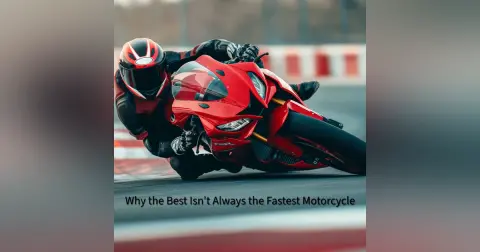
When it comes to motorcycles, the allure of power and speed is hard to resist. We’re often drawn to spec sheets boasting big horsepower figures, enormous engines, and top speeds pushing the limits of what’s legal—or even safe—on public roads. Yet, as countless seasoned riders will tell you, the best isn’t always the fastest. There’s far more to the perfect motorcycle than raw acceleration or a headline-grabbing top speed.
Big-displacement bikes, such as large American cruisers or record-holding Triumphs, are impressive on paper. Their massive engines deliver plenty of torque and highway presence, but they also add significant weight and bulk. That extra heft can make motorcycles harder to maneuver, less agile, and more challenging (and expensive) to own and operate. For smaller riders, or those who want to enjoy twisty roads or city streets, these bikes can quickly become more burden than blessing.
On the other end of the spectrum, high-horsepower sport bikes like the Ducati Panigale V4 R or BMW M1000RR offer breathtaking performance. However, their capabilities far outstrip what’s usable on most public roads. Riders often find themselves barely scratching the surface of these bikes’ power, which can lead to a less engaging and sometimes uncomfortable experience, especially over long distances. Excessive power can also mean lower fuel economy, more maintenance, and a riding position that sacrifices comfort in the pursuit of speed.
That’s why many experienced riders gravitate toward “Goldilocks” motorcycles—middleweight bikes that strike a balance between power, weight, and usability. With moderate horsepower and manageable weight, these bikes are often more fun, more practical, and more affordable. They allow you to explore the full range of the engine, develop your riding skills, and enjoy every ride, not just the rare moments when you can open the throttle wide.
Ultimately, the best motorcycle for most riders is the one that fits their needs, riding style, and ambitions—not necessarily the fastest machine available. Remember: Best isn’t always the fastest. True enjoyment comes from finding a motorcycle that you can master, not just one that can outpace the competition.
Thanks for listening!
Click the "Send us a Text Message" link above to send us your questions, comments, and feedback on the show! Please make sure you leave the podcast title. Or if you prefer to leave an audio message, leave us a voicemail on our website!
Subscribe to our newsletter to keep up to date on the latest from the show.
Check out our favorite products to use on and off your motorcycle.
It's more fun to ride a slow bike fast than a fast bike slow. Welcome to the Throttle & Roast Podcast. I'm your host, Niels Meersschaert. In today's episode, I'll be looking at the best motorcycle is usually not the fastest. Most of us aren't racing motorcycles professionally. In fact, a good portion of us have never taken a bike onto a track. Yet we often peruse the spec sheets of the newest bikes and ogle at the horsepower and torque figures... or even just the displacement. And while these quantifiable numbers make it easy to compare one motorcycle to another, they tell only a portion of the story. And they may not mean that it's the best bike. So let's start with displacement. This is usually one of the first things that people will use to describe a motorcycle. They'll say, "Oh, how big is your bike?" And they're referring not to the size of the bikes physical exterior dimensions. Most of the time, they're usually referring to the displacement of the engine. So you might respond and say, "Oh, I've got 1800 CC or I've got a 900 CC or even a 300 bike." And that's a description of the displacement. In general, a larger displacement bike has more power than a smaller displacement bike. And the most important thing is that the engine is in cars all the time. The larger the displacement, the more power and torque that the engine is capable of producing. And the very largest displacement motors that we have on the market today tend to be in large size cruisers. A lot of American cruisers, for example, would put this into cubic inches and it might be 119, 117 cubic inches. And I'm going to put this into a liter. But most other engine sizes are always done in liters. So I'm going to stick with liters and cc's, which are just, you know, you can think of 1800 cc's as 1.8 liters. It's a lot easier just mathematically to figure out than the cubic inches. So most are around that 1800 to 1900 cc range. In fact, my BMW R18 is named R18 because it is an 1800 and two cc engine. But of course, the largest displacement engine on the market today is the Triumph Rocket 3, which is 2500 cc's. These are huge, huge engines. In fact, they're similar displacement to many of the cars that are on the market today. if you look at most regular cars that are out there, they're in that 1.8 to 2 liter engine size. That's a pretty common size for a lot of even up to like two and a half liters. It's pretty common that you'll see amongst the size of a car. Now obviously, a motorcycle is significantly lighter than a car, so we have a huge engine relative to the size of the car. Now, oftentimes these big engines also mean big weight to the bike. the engine itself is going to be a significant portion of the bike's weight. And because it's physically large, it needs more mass. It's going to have more metal in there. It's going to just weigh a lot more. And because the engine weighs a lot more, your chassis has to weigh more because it has to have more strength in order to hold it. The suspension arms have to be thicker and wider in order to hold that type of weight. Your wheels have to be larger and stronger. So everything gets sized up when you have this. And this is why if you look at a typical big Harley or big Indian or whatever other bike has out there, they're going to be a lot of weight. Like for example, a Harley Street Glide is 811 pounds. A Harley Road Glide is 838 pounds. These are really big bikes. And if you look at the limited series where they add in the tour pack, the Street Glide Limited is 893 pounds. And the Road Glide Limited is 919 pounds. It's almost a thousand pounds in a motorcycle. These are big, big bikes. Now, ironically, the bike that the physically largest engine is the Triumph Rocket 3. But that bike is only about 700 pounds, which relatively speaking is significantly lighter than some of these others. But a little bit of that is because they do try to make it more of a... . . . . sporty kind of a bike, rather than more of a laid-back cruiser weight. Even my own R18 Classic is 805 pounds, that's with the saddlebags and the windshield . cruisers will often tend to have a very long wheelbase to also hold this bigger engine. The engine is physically wider, it's physically longer, and therefore chassis dimensions have to be larger to accommodate it, so their wheelbase tends to be fairly Going back to a couple of the ones that I gave as examples before, the Street Glide and the Road Glide, both have a 64-inch wheelbase. . . . . . the Triumph Rocket 3 is 66 inches, and my R18 Classic is 68.1 inches. These are really long, long bikes. And you hear this, and you're hearing these numbers, and you're saying, "Oh, well, that's cool, who cares?" Like, big numbers, whoop. . . . . but there's some issues with this, and this is sometimes getting a large displacement bike . . . . and I'm using the cruisers just as the extreme, but you could move this into saying, let's say, a 1200cc versus a 900cc bike . .. . . . versus a 900cc bike, the relative idea still applies. And that is that large displacement engines tend to be more expensive. So cost is a huge factor. You're getting a much more expensive bike than if you've got something that had a smaller displacement. The weight that we talked about, you know, you hear this number of 800, 900 pounds and you say, well, okay, it is what it is. The thing is that if you're a smaller rider and you're trying to move this size of a bike around, especially in your garage, or maybe trying to pick it up after you've dropped it, it's a real challenge. These are behemoth, really heavy bikes. And let's say you're a 200 pound rider. You have a bike that weighs four times your body That's a really big, big bike. And when you go into a turn, that weight has to still turn and change direction. It will not change direction as quickly as something that is lighter. So they aren't going to handle as well. They won't be as quick to accelerate. And the stopping distances will also be increased because they physics gets in the way. force equals mass times acceleration. You cannot a large mass as quickly as a small mass without having significantly more force. So they are a problem. And the long wheelbase that we needed to stretch to hold big, big engine in the chassis. Well, longer wheelbases are also slower to turn. Think of a large delivery truck versus a regular car. The turning radius is much, much smaller in a car compared to that big delivery truck. Well, the same thing happens when you have a shorter wheelbase motorcycle versus a longer wheelbase motorcycle. It cannot turn as quickly. And you put it into your garage and you've got this huge, long wheelbase. Well, now you need more space in your garage in order to fit it. It may not work for you to realistically fit this big, big in your garage. Or if you wanted to hold multiple bikes, it's a lot more challenging with big bikes as compared to a more moderately sized motorcycle And the big thing, I think, still with that longer wheelbase is it's going to have a longer turning circle, which means it's even more difficult to turn around in your garage. So you've really got to think about, am I going to pull the bike straight in or am I going to back the bike into the garage so I can get out of garage much It becomes challenging as you start to think of this. So large displacement bikes, while I think they have a tremendous amount of character and owning one myself, that's just how much the bike is going to have. It's going to be the biggest thing that you're going to have. But it's not always the best is the point I'm trying to get out. There are trade-offs and you need to decide for yourself as a rider, whether those trade-offs are the right setup for you. And they may be, but they may not be. And especially if you're a smaller rider. And this is the thing I find so ironic with a lot of the big cruisers, a lot of very small, short riders tend to get these big cruisers. And it's a big bike for such a small person to be managing around. So it is a challenge and there might be another bike that might be better suited to you. But let's switch gears and let's go into the other part of the equation. When we start to think of the spec sheets, it's not just the displacement, but we also start to look at the horsepower and the torque figures. And these are really easy to compare and say, "Oh, well, I've got this really powerful bike versus this very little power bike." And in general, displacement does scale generally with horsepower. To a when you get into a lot of the engines that were used in, like the cruisers that we just discussed, that's not always the case. They often emphasize more on torque than on raw horsepower because it's such a engine. Getting it to spin at a very high RPM, especially if it's a twin, is really challenging to be able to just get that type of speed out of it, which is where you get your horsepower. But if we look at some of the bikes that are going to be some of the highest horsepower on the bike, on the motorcycle world today, bikes like the Ducati Panigale V4 R, this is 208 horsepower. And if switch it into its course setup, it's 239 horsepower. And all this is out of a bike that weighs 438 pounds. ratio, it is insane what some of these bikes are able to produce. That bike will easily do 0-60 in less than three seconds. The top speed is close to 200 miles an hour. Or look at the BMW M1000RR. It's 218 horsepower, so in street-ready form, it's actually more powerful than the Ducati. It's 425 pounds, even a little bit lighter, and 0-60 once again is in less than three seconds. The quarter mile for the M1000RR is in less than 10 seconds, and it has a top speed of about 190 miles an hour. It is a very fast, very quick motorcycle. Even if we take out of the sport bikes, because those are two good sport bike examples. Look at the BMW R1300RT or even the GS. Both of these bikes, they have the same engine in them. It's 145 horsepower, and they'll do 0-60 in about 3.3 seconds. So yes, they're slower than the sport bike, but faster than a large percentage of sports cars that are on the market today. These are insanely fast bikes. But the thing is that you have to start to look at this stuff from a perspective of, is too much too much? And sport bikes are amazing bikes for the track. But on most public roads, you're at the highest speed limit in a couple of seconds, and their top speeds are more than three times the speed limit of most highways. So you're barely using any envelope of the motorcycle. Now, I owned for about a decade a BMW S1000R. So I can count on one hand the number of times that I held full throttle for more than about two seconds. Now my bike was the R, so it was tuned a little bit more for the street. And thus it only had about 160 horsepower. Whereas contemporaneous double R version was about 190 horsepower. But as a result, my bike had more torque. So it was a little bit more tractable and usable on the street than the double R version would be. And while it was a lot of torque. And while it was a lot of fun, I just felt I could never use the bike to its fullest potential on public roads. Now on the track, totally different story because you're not worrying about cars passing in front. You're not worried about a blind corner. You're not worrying about deer running in front of you. You can really push it on the track. And it's a huge blast on the track. But on public roads, you're barely, barely twisting that throttle at all. And it felt almost neutered in a sense of what you wanted to be able to do with it. The other thing I'd say with sport bikes in general is some people will actually refer to them as contortion devices. They are not comfortable. I did a 500 mile day once on my S1000R. And this was, I used to run a trip all the way from New York City up to Canada. we basically did two routes. We had a street route and then I had dirt route. And we kind of meet for lunch between the two routes. And then we'd meet for camping each night. We'd go all the way up to Jay Peak right on the Canadian border. But then coming back home was like a 500 mile day just to get back home. And I did this on my S1000R where I led the street version one And I will say I was just exhausted after that ride. I could barely move. My hands were numb just from the vibration of that motor. Because at highway speeds, when you're stuck at steady speed, that motor just horrible little vibrations that just get into your hands. And you're just exhausted more than you could ever imagine. And this is a real problem for how you might think of, you know, just continuing to ride. Now another problem with sport bikes in general or any sort of really horsepower motorcycle is is that the gas mileage is not quite as good. That high power does yield low fuel economy. Now my S1000R, over a decade of ownership, averaged less than 37 miles per gallon. And the irony is, with these bikes, is even though the gas mileage was so bad, and it wasn't comfortable, you're almost always at no more than half throttle in most riding conditions. Because you just, you don't need it. It's got so much power on tap that you're never using all of And so it's almost overkill. It's, it's fun. I'm not saying it's not a, a cool thing to have it, but you're never using it. And I, I think that's the sort of the real trade off for this. And so if we start to look at some, maybe more moderate bikes, and this isn't meaning you have to go to the low extreme of like a small little bike. A small little bike, let's say like my Vespa, the 300cc Vespa. It's 22 horsepower. I am on full throttle a lot of the time on that bike. It's almost the polar opposite to my sport bike. But that doesn't have to be where you have to go. I don't think it's like, hey, I either have a sport bike or I have a scooter. I think there's a nice middle ground that's probably more meaningful for a lot of riders. And so I would say if you were thinking of maybe you wanted a cruiser style bike. Well, maybe look at something like the Triumph Speedmaster. Now this is 584 pounds. So more than 200 pounds lighter, even sometimes 300 pounds lighter than a typical large scale cruiser would be. The wheelbase is 58 and a half inches. So six inch shorter wheelbase on average than a lot of those other bikes. And it's 77 horsepower. It's not going to be a overwhelming amount of power, but it's going to be a nice usable amount of power out of that bike. Now, the irony is most of the big cruisers might put out, let's say like 90, maybe 100 horsepower because again, they're more torque oriented. This is not that down on power, but to be 200 pounds lighter, your power to weight ratio is actually better on this. So you actually will use the bike and get more performance out of it than you would with that large cruiser. And there's an aesthetic to the large cruisers. There's a there's an engine sort of character that is unique to it. So I can understand why some people may not want that, but just from a practical perspective, the Speedmaster is a really good option for a lot of riders. And if you say, let's say you're an American rider and you're like, it has to be an American bike. Well, you can also look at like things like the Harley Sportster S. Now, there are some purists who will complain about it's not air cooled, and I understand that. But this bike weighs 502 pounds. It has a 59.8 inch wheelbase. So again, a good four inches shorter than those bigger Harleys and 300 pounds lighter than them. It's 121 horsepower. It's more of a sport bike in a sense. So it's actually got a lot more power, but out of a much smaller package. So if you wanted to have a cruiser look, but a little bit more oomph to it, the Sportster S is a really cool option. Another one, if you wanted to stick to the American bikes, look at the Indian Scout. It's 105 horsepower or 80 horsepower in the Scout 60 variant, and it's 540 pounds. It is significantly lighter than these other bikes and more manageable, especially if you're a smaller rider, I think it's probably a better bike for most of those type of riders. And what if you are not necessarily into the cruisers? Well, as I talked about, like some of the sport bikes or even the sport touring bikes like the R1300 RT or even the R1300 GS from BMW. Think of the KTM variants that are much in the same way. The Kawasaki Concours. All of these high power sport touring bikes are really pretty much up there. And when it comes to weight, power, everything is sort of supersized. Well, maybe look at some of the more moderate middleweights. Look at bikes like the BMW F900GS. This is 105 horsepower and 480 pounds. I actually switched from my R1200 GSA, which was 560 pounds and 110 horsepower, to an F900GS. I gave up 5 horsepower, but I also gave up 80 pounds of weight. My new bike is more sporty feeling than my old GSA was by a long shot, even though it is a smaller capacity bike, even though it is a lighter bike. It's better in off-road, it's better fun through the twisties, and it's significantly cheaper. There's a reason why middleweights are becoming such a popular category, is that we've gotten so ingrained with that we had to have these massive, huge displacement, high power bikes. When you'd really don't, and I think like a hundred horsepower, to me, it's the real sweet spot. That's why I like bikes right around Now, the other bike I'd say that would be really good if you'd like that sort maybe less of an adventure bike, but you just like a good, solid, know, naked bike, let's say, or even some of the sport touring variants of this, but look at the Triumph Trident It's 113 horsepower. It's 437 pounds. It's a much lighter, much less powerful than the 200 horsepower sport bikes, but it's a more usable amount of power on that bike. And the big thing, and I'll come back to what I opened up with in the, it's more fun to ride a slow bike fast than a fast bike slow. Any of the bikes that I just shared are in this 80 to 120 horsepower range that I feel is really the sweet spot for most street riding. Street riding. If you're on a track, yeah, you want more power, but if you're on the street, that's going to be a tractable, usable amount of power. It'll be fun, but you'll be using more of the power band during your ride, which can be a lot more fun. You know, you've got enough power on the ride to ride in that spirited manner. It's not so much that you feel that you barely have to use the throttle and you'll be pushing the bike to its limits far more often. Picking the right gear is even more critical. While in a bike that is overpowered, it almost doesn't really matter. You can be in six gear and still roll on your quote unquote lugging the engine, but it's still going to accelerate so insanely fast that who cares. It's so effortless that it starts to feel boring, but this is where the fun bit of having a bike that's more in that middle ground. You know, you can ring the throttle out. You can rev the engine to red line. You can carry massive corner speed without breaking the law or your And as enthusiasts and racers alike often point out, mastering a slow bike requires you to carry momentum and hone technical skills like late breaking and maintaining corner speed because you cannot rely on straight line horsepower to make up for mistakes. And if you look in the auto world, one of the most popular cars for people who are doing the weekend race, they take a car out to the track, or even just if they want to run around on their own is the Mazda Miata. And you'll often hear people say Miata is always the answer. This is a very lightweight car, but not a lot of horsepower. It's maybe about 180 horsepower for a car. That's not a lot in today's world Mustangs will have five, six, seven, 800 horsepower without a doubt. 180 horsepower feels really, really small, but the car itself is significantly lighter than those other cars would be oftentimes by over a thousand pounds lighter. That's going to let it turn faster. It's going to let it get through the corners much faster. It's going to let you drive the car to its edge much more because you have to be using the gears. You have to do it. The same thing applies onto motorcycles. So let's wrap up. We talked about some of ways in which people will think of it's easier to look on a spec sheet and decide which bike they wanted to without really realizing, do you need all of that? So we started with some of the large displacement bikes and how sometimes these large displacement bikes also mean that they're heavy. They're expensive. They're not really good handling, so they may not be as ideal. And then we also looked at some bikes that maybe are more moderate in terms of their weight, but have a huge amount of horsepower and cost still. Things like sport bikes or some of the high-end sport touring bikes. And finally, we looked at how some of more middleweight type of bikes might actually be the Goldilocks version. They're going to give you enough power to have fun, enough power where you're having to actually use more of that power rather than just being barely scratching the surface twisting that throttle, and have a good time. So my question for you this week is, do you prefer riding a fast bike slowly, or do prefer to ride a slow bike quickly? Share your thoughts through the text to show link in the show notes, or leave a voicemail at ThrottleandRoast.com slash voicemail. Thanks for listening. I'll talk to you next week.
