

 Apple Podcasts
 Spotify
 iHeartRadio
 Podcast Addict
 Amazon Music
 Podchaser
 Castro
 Castbox
 PocketCasts
 Deezer
 PlayerFM
 Goodpods
  RSS Feed
 Trail Braking: The Key to Smoother, Safer Motorcycle Corners
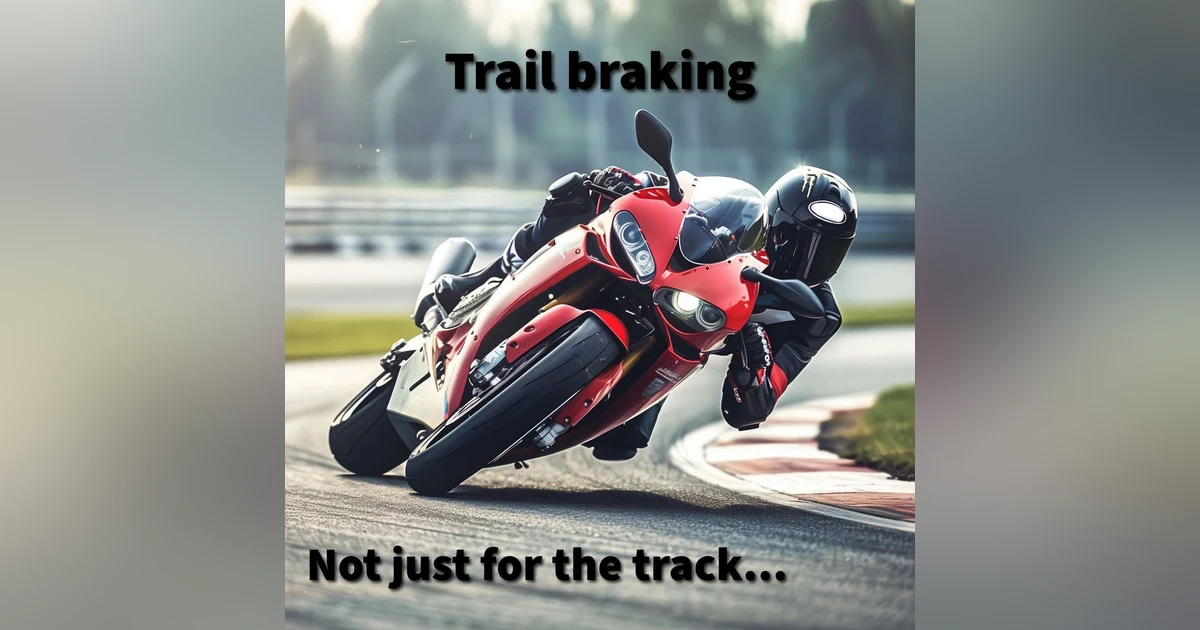
Trail braking is a vital technique for motorcyclists who want to improve their cornering skills, ride more safely, and boost their overall confidence on the road. In this episode, we dive deep into the mechanics and benefits of trail braking, explaining why it’s a must-have skill for riders of all levels. Whether you’re just starting out or you have years of experience, understanding and mastering trail braking can be transformative for your riding.
We begin by demystifying what trail braking actually means. Unlike traditional braking, which is typically completed before entering a corner, trail braking involves continuing to apply the brakes as you lean into the turn, gradually easing off as the bike reaches its apex. This technique allows riders to better control their speed and weight distribution, making cornering both smoother and more predictable.
Our discussion covers the science behind why trail braking works. By maintaining a slight brake pressure into the corner, you keep the motorcycle’s front suspension compressed, which increases the front tire’s grip. This enhanced contact with the road surface offers greater stability and allows for quick line adjustments if needed. We also explore how trail braking can help in emergency scenarios—by keeping more options open if a hazard appears mid-corner, reducing the risk of target fixation or running wide.
Practical tips are shared for learning trail braking safely. We emphasize the importance of practicing in a controlled environment, such as a closed course or empty parking lot, before trying it out on public roads. Key points include starting with gentle brake pressure, focusing on smooth transitions, and always prioritizing safety over speed. We also highlight common mistakes, like grabbing too much brake or releasing pressure too suddenly, and offer advice on how to avoid them.
Whether you’re looking to upskill your riding or simply become a safer motorcyclist, trail braking is a technique worth adding to your toolkit. This episode provides actionable insights to help you get started and progress with confidence.
Thanks for listening!
Click the "Send us a Text Message" link above to send us your questions, comments, and feedback on the show! Please make sure you leave the podcast title. Or if you prefer to leave an audio message, leave us a voicemail on our website!
Subscribe to our newsletter to keep up to date on the latest from the show.
Check out our favorite products to use on and off your motorcycle.
00:00 - Introduction
00:32 - What is trail braking?
02:33 - How do I trail brake?
06:54 - Why should I use trail braking in everyday riding?
10:24 - Wrap up
Courage is the throttle and fear is the break. Welcome to the Throttle and Rose podcast. I'm your host, Niels Meersschaert. In today's episode, we'll be discussing trail braking. Some think it's an advanced technique only useful for the track. Othe think it's part of everyday riding. We'll discuss what trail braking is and how you can add it to your riding and why you might want to use it on every corner. So let's get started with what is trail braking? Well, the Wikipedia definition says that trail braking is a driving and motorcycle riding technique where the brakes are used beyond the entrance to a turn or turn in and then gradually released and trailed off. And depending upon a number of factors, the driver fully releases brake pressure at any point between turn in and the apex of the turn. So that sounds very clinical. It sounds very but let's kind of get into a little bit of a real world definition, something that actually might make it kind of make more sense to you as a regular So thing of trail braking really is it's when you're continuing to bleed off after the turn has already begun and up to the point where maximum turning force is needed. Essentially, you're maximizing the grip of your tires. You're shifting from providing full breaking force to full turning force, but without the gap of no force in either direction that braking only before the turn provides. So think of it almost like a budget. Your tire has a certain amount of grip available and it can be used for any of three It can accelerate, it can brake, and it can turn. And if you're using maximum braking force, there's no budget left over for Likewise, if you're using maximum turning force, there's no budget left over for braking or acceleration. But there are times where you can share the budget between braking and turning or turning and acceleration as long as the sum of the grip is no more than the maximum grip available for the tire. And essentially, you're balancing the amount of lean of the bike with the amount of braking pressure. As the bike leans more, you reduce your braking force. When the bike is at the maximum lean angle for the turn, you've tapered off all braking pressure. And remember that engine braking is still braking. And while it's not as strong as you're using your brake, it still slows the bike down and uses some of that budget of grip. So how do you do trail braking? Well, the easiest is to show what not to do. Imagine you're coming into a corner. You grab the front brake to slow the bike as much as possible for the turn. The front fork compresses, the trail of the bike reduces The wheelbase even shortens a little And now you let go of the brake before the turn. all that pressure that was on the front fork releases. The spring in the fork tries to lift the front of the bike up, now reducing the grip at the front wheel, right as you start leaning and asking it to have At the same time, the trail in the wheelbase increase, which slows down your turning ability. So think of this as when you do it in the sort of way we're oftentimes taught early in our riding career, like do all the braking before and then you come off. The real key is it's not so much that you don't do the braking before the corner, it's how you let off of the brake. So if you just release the brake completely, that's going to be a abrupt change of removing that braking force. So to do it the right that abruptness of that first example of the classic brake is where it actually can become a problem. Instead, think of this really as a transition between two different modes. You slow down as you would have in the past, but keep applying the braking pressure. Remember 70% of the braking is in the front brake. So don't just use the rear brake. And as you start to lean the bike, you begin to reduce the pressure on the brake. You don't fully release it. Rather think of it as a trade-off between leaning and braking. Remember that once you fully release the brake levers, the bike still has some engine braking going on. And this is your final bit of trail braking. Now you can hold throttle to maintain the speed as you go through the which would remove that engine braking component. Now, as you begin reducing the lean angle of the bike, as you exit the corner, you can start to apply more throttle to accelerate. And this is essentially the opposite of trail braking. Once the bike is fully upright, you can be at full throttle, if you since all the grip can now be used for acceleration. And while that might sound a little complicated of, "Oh my God, I got to manage all these things, I'm slowing and then I'm slowly releasing the brake as I'm turning the bike." The best way to think of this is really the key thing that is the differentiator of trail braking versus maybe the way you initially started turning or initially learned to brake and turn with a motorcycle. It's really about smoothness. So the best way to think of this is really it's visualizing trail braking is you're smoothly transitioning between the braking and the turning and then the accelerating out of the corner and the smoother you achieve this the less jerky the bike will feel as you enter a corner and it will also feel less jerky as you exit the corner. Try also to increase the lean smoothly, not just doing a quick slam into a full lean, but a gentle transition from upright to full lean. And gentle refers not to the total time, rather how consistent the rate is. If you're jerky, you might go from upright to full lean in two seconds, but it's done in three steps to different lean angles each with a half a second pause in between them. Smooth would achieve it in the same two seconds, but the rate of change is constant you're really just trying to make it smooth. So think of the jerkiness that you might have experienced as you were going into a corner in the past, maybe you were jamming on the brake, then you were letting go of the brake, then you were starting to lean and you leaned a little bit and then you leaned a little bit more and you leaned a little bit more and the bike just feels like it's jerking around. That's the thing that's going to become problematic because when you're jerking the lean of the motorcycle, as you go into a when you actually ask it to do a really quick lean, you're asking it to actually put more turning force for that moment. When you're doing that transition into specific lean and so you're actually using up more of your grip. So that's why the bike might feel like it gets a little loose is because you're being really, really harsh with your movement. So really think of it as smoothness is the The more that really do this as a transition and you're smoothing how you turn and how you brake and how you accelerate, you're going to come out with a far better outcome of the corner. You'll just feel more aware of it. So you might be hearing this and saying, yeah, but this is a lot of work. This is way too complicated. I don't want to be thinking about all this stuff while I'm trying to ride the bike and go through a corner. And the thing is, is it will become easier as you practice it more. And really with anything in motorcycling, we should be practicing and endeavoring to hone our craft every time we get on the bike. Think of something that you maybe struggle with. Maybe you're not perfect on quite yet and say, hey, how can I make that a little bit better?And what I would encourage you also, if you are getting into starting take advantage of trail braking, don't put it to the maximum extreme. So think of that budget analogy that I described where you have like a maximum amount of Only use like 70 or 80% of your maximum as your total. And then this way you've still got some buffer if you mess up. If you've got, you put in too much braking or you didn't transition well into the turning, you've still got a little bit of a buffer range. And that's probably a good thing to do anyway, anytime you're on the street, as opposed to on the track. Track, you can maybe get closer to that 90, 95, 100% kind of usage of your grip. But on the street, I'd say, hey, think of it more as that 80%. And if you think of that now transition, you're 80% as being 100% of your grip. Well, now your transition, you know exactly what you have to balance. But the reason why you want to be using trail braking is remember that when you transfer that weight to the front by compressing that fork, you're reducing the trail, which is going to give you more turning. And this actually helps you turn more effectively. And there's a reason why Keith Code from California Superbike School teaches using trail braking always, not just on the track. The other thing is this gives you a safety factor for an emergency stop and a turn. Since your hand is still on the brake you can quickly stand the bike upright and apply maximum brakes in the event of something appearing in the middle of a corner. If you've fully removed your fingers from the brake, and maybe even just move them right onto the grip again, it's gonna take you a moment to get your hand back onto the lever and then be able to squeeze that brake to slow the bike down. So, keeping your finger covering the brake lever, even if you have your braking, is also a good technique to use as you're going through a corner. Again, we're just trying to maximize how smoothly you get through the corner and then how safely you get through the corner. And this is by trail braking, I think, is something that we don't really use enough on the street, and it doesn't mean you have to be riding around like you're a MotoGP racer, but just think of it as how do I really hone my craft to be as smooth as possible? And I'm transitioning from all braking to all turning and then back into all acceleration, but it's not a light switch. Think of it as a rotary dial, think of it as a transition between them. And this is where you really will improve how effective it is. And then also, the big thing that you'll start to feel is the bike doesn't feel like it gets upset. It doesn't feel like it's sort of transitioning and wallowing a little bit. And you see this quite often with some riders they kind of do this very harsh, abrupt, they brake really, really hard and then they let go of the brakes and the bike lifts up then they do the slam into the corner of the lean and it just really feels very herky-jerky. And it's hard for you to have a feeling of smoothness as you're getting through that corner if you're not really focusing on being smooth. So let's wrap up. We discussed what trail braking is. It's the smooth transition from braking to leaning tires are split between both of them through the corner. We also covered specifically how do you do trail braking? What are the techniques? And finally, we discussed why you should be doing trail braking, both from a maximum turning advantage as well as for added safety. So the question I have for you this week is, do you use trail braking in your everyday riding? Why or why not? Share your thoughts through the text to show link in the show notes or leave a voicemail at throttleandroast.com/voicemail. Thanks for listening, I'll talk to you next week.
