

 Apple Podcasts
 Spotify
 iHeartRadio
 Podcast Addict
 Amazon Music
 Podchaser
 Castro
 Castbox
 PocketCasts
 Deezer
 PlayerFM
 Goodpods
  RSS Feed
 GVWR Reality Check: You’re Overloading Your Motorcycle
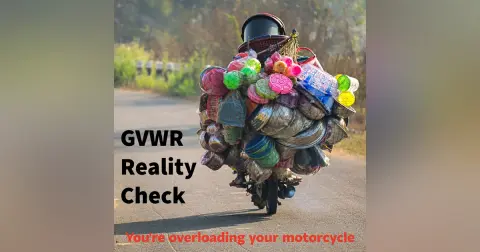
When it comes to motorcycle safety and performance, a "GVWR reality check" is essential for every rider who plans to carry passengers or luggage. GVWR, or Gross Vehicle Weight Rating, is the maximum total weight your motorcycle can safely handle, including its own weight, fluids, accessories, rider(s), and all gear. Many riders are surprised to learn how quickly they can reach or exceed this limit, especially when riding two-up or packing for a longer trip. Ignoring GVWR is not just a technic...
When it comes to motorcycle safety and performance, a "GVWR reality check" is essential for every rider who plans to carry passengers or luggage. GVWR, or Gross Vehicle Weight Rating, is the maximum total weight your motorcycle can safely handle, including its own weight, fluids, accessories, rider(s), and all gear. Many riders are surprised to learn how quickly they can reach or exceed this limit, especially when riding two-up or packing for a longer trip. Ignoring GVWR is not just a technical oversight—it can have profound implications for your safety and your bike’s longevity.
Understanding GVWR starts with knowing the difference between dry weight, curb (wet) weight, and payload. Manufacturers often highlight the lowest possible weight for marketing reasons, but it’s the fully loaded, ready-to-ride number that matters when calculating your actual carrying capacity. Subtracting the curb weight from the GVWR gives you the payload, which is the total amount you can safely add—rider(s), gear, and luggage. For most motorcycles, payload falls between 400 and 500 pounds, which can be eaten up quickly by two adults and a few bags. If you haven’t done the math on your riding weight—including clothing, helmet, and accessories—you may be closer to the limit than you think.
Overloading your bike has real-world consequences. As you approach or exceed GVWR, stopping distances increase, acceleration drops, and handling can become unpredictable, especially in corners or with a shifting passenger. Excess weight puts added strain on brakes and tires, leading to faster wear and higher maintenance costs. Tire failure due to overloading is a serious risk, and a blown tire while riding is potentially catastrophic. The chassis and suspension are also only designed to handle so much weight, and exceeding the limit can lead to premature wear or even structural failure.
To manage your load responsibly, get into the habit of checking your preload and tire pressures before every ride, especially when you switch between riding solo and riding two-up or with luggage. Consider riding solo, investing in lighter gear, or splitting luggage between bikes if you routinely travel fully loaded. Ultimately, respecting your motorcycle’s GVWR is a simple, vital step toward safer, more enjoyable riding.
Thanks for listening!
Click the "Send us a Text Message" link above to send us your questions, comments, and feedback on the show! Please make sure you leave the podcast title. Or if you prefer to leave an audio message, leave us a voicemail on our website!
Subscribe to our newsletter to keep up to date on the latest from the show.
Check out our favorite products to use on and off your motorcycle.
00:00 - Introduction
00:37 - Terminology
04:03 - Why does it matter?
06:39 - Tips for managing the weight
11:43 - What happens when you are overloaded?
15:43 - Example GVWR, curb weight & payload
21:39 - Wrap up
Weight is the enemy of performance. Welcome to the Throttle and Roast podcast. I'm your host, Niels Meersschaert. In today's episode, we'll look at loading your bike. You've probably seen those images of bikes overloaded with goods being brought to the market in Asia on a tiny motorcycle. And you might think that's crazy on such a small bike. But while the load goes up with bigger bikes, so does the weight and what you can carry might not be as much as you might think. So let's start with a few different terms that are really important to understand when you're thinking about your motorcycle and how you're going to load it up when you want to carry gear, passengers, anything that you're trying to And the first one that we're going to deal with is called GVWR. Now GVWR stands for Gross Vehicle Weight Rating. This is maximum amount of weight that your vehicle can be while it is rolling along the This includes everything. This includes the bike's weight itself, any fluids that are on the bike, any fuel, any passengers, any accessories that you've added on, any luggage, everything. This is the maximum weight that the vehicle can Now, another term that we have to think of is what's often called wet weight or curb this can be a little challenging to find for some motorcycles because some motorcycles will only list their dry without any fluids like oil or gas or coolants. And of course, gasoline weighs about six pounds per gallon. So a typical bike will generally have about 50 pounds of fluids over the dry weight in order to reach the curb Now, some motorcycles will some of the fluids, but not all of the fluids. And this has to do with marketing. They're trying to sort of suggest weight number that is lower than what you actually have of curb weight So that when you're trying to compare like for like on different bikes, it will appear that this bike is lighter. But it's really important when you're trying to calculate what you can bring with you on the bike in order to figure out what the true wet weight or curb weight of your motorcycle is. Now, of course, one thing you could do is you could get a pair of bathroom scales, for example, and assuming that they're able to support enough weight on each one, you could roll your bike such that each wheel is on each bathroom scale, measure how much weight is on each scale, sum them together, and now you have your actual wet weight. The cool thing about this is that you can actually then measure the bike with all the Farkles you might have added onto it, but before you add in any luggage or anything that you're adding into the luggage more than the point, and passengers. Now, where this becomes important is we need to compare the gross vehicle weight rating with our wet weight. And effectively, if we subtract the wet weight from the gross vehicle weight rating, this tells us how much payload we can do. And this is sometimes also called useful load. This is the weight that you can add to your bike across the rider, the passenger, The thing is that this can disappear quite quickly. You'd be surprised how little payload most motorcycles have. In fact, most motorcycles have only about 400 to maybe 500 pounds of payload. So a 250 pound rider might struggle to accommodate another 200 pound rider plus a little bit of luggage. So this is something that you have to really focus on when you're loading up your bike. And if you're riding solo, and you've got 400 to 500 pounds of payload, you're probably okay. The problem is for those riders who are riding two up. And of course, if you have two people, you probably want to carry even more luggage. And odds are that if you're riding on one of those, let's say, big touring bikes with two people loaded up with everything in the kitchen sink, you're probably overloading your bike. And now, why does this matter? Why do you even care if you've overloaded the bike? Well, the thing is, even as you get close to the GVWR, even if you're not over it, the bike is going to take a little bit longer to stop. You've just got so much more mass that it's trying to slow down. It's going to put a lot more strain onto brakes in order to slow the bike down. It's going to be harder to turn because again, you're trying to turn a huge amount of mass and this can make it a little bit unstable as you're going to slow down. going through cornering because the bike might sort of wiggle around a little bit and you might be weighted a little bit more towards the rear than the front. And so what happens is the bike might actually feel like it wants to push through a corner as you're trying to Now another thing you're going to run into is that the bike will be less fuel efficient. So what does this mean? Well, it means that you are going to have to be filling the tank far more often because the bike is going to be burning gas at a much faster rate than if it was loaded less heavily. It's going to also be very slow to accelerate. Just think of the inverse of Well, you've still got to now accelerate all of that mass. So it's just going to take a lot longer to get up to speed. And of course, we talked about a little bit of that worse handling. Well, the thing is the handling is really going to be the problem, especially if you have an extra passenger on there with you who might be maybe let's say wiggling around a bit on the back. That's going to shift the weight pretty dramatically on the bike and it's going to become much harder to be able to get a smooth line through a corner. Now, the thing is for some riders, they may not ever really ride the when it's not fully loaded up and they might think that it's completely normal that this is the way that a bike feels while you're riding. And if you're always riding two up, for example, you might just be used to that. But the thing is, is that that's not necessarily how your bike is meant to ride. And the thing to remember, too, is that when you're comparing payload, and I see this all the time when people are looking at making adjustments, for example, for like preload on a bike, don't use the weight that you have when you get onto the scale just in your underwear in the morning and you're just, OK, how much do I weigh? That is not your riding weight. you've got your clothes on. You might have your riding gear on. You've got your helmet on. All of that is adding extra weight. And it's probably adding another 15, maybe even 20 pounds of weight onto your bathroom scale weight. So you really have to compare what your riding weight is when you're looking at what the real payload is. So what do you have to do when you get close to gross vehicle weight rating or even if you're overweight? Well, of course, if you're not overweight, as I just mentioned a moment ago, you have to adjust the preload to match the load. And I see this far too often. Most people never, ever, ever touch the preload on their bike, let alone adjust it for the load that's coming on. So if you're riding and switching between riding solo and riding with two up, you've got to adjust the preload. If you're adjusting between you riding solo and with bags and with luggage and stuff that you're carrying, you have to adjust the preload. It's really important to do this the other thing I'd say is check your inflation. More often than not, you actually want to add a little bit more inflation into your tires, get a little bit more PSI running in there as you're getting closer to a heavy, heavy load. This keep the tires from deflecting too much just from the normal load of the bike and everything that you're carrying on top of it. And the thing is that remember that if you have a tire that is as underinflated as just 10%, your load capacity drops by far more than that. So your tire is defining in combination with the chassis what your total load capacity is. And the other thing is when you're checking your tire pressure, remember that these are cold tire pressures, not hot. So if you've just been riding for a little while and now you've got to measure it, your numbers will seem off. It will look like the pressure is higher than it would be if you measured it cold. And then if you remove air from it, now you're actually creating more of an issue. So really pay attention to your tire pressure along with the preload when you're getting your bike ready. But let's say that you have not just gotten to the point where you're close to GVWR, but let's say that you're actually over GVWR. Well, obviously one of the simplest things you do and probably is the biggest impact in terms of getting you under this weight limit is riding solo instead of two up. It's just a fact of it is that motorcycles are lightweight vehicles and they're not meant to carry a lot of passengers. And if you are a bigger person, if you're a heavier person, and maybe the person you're riding with is also bigger and heavier, the odds that you are going to be overweight increase dramatically. So it's really, really critical to pay attention to this. And if you can ride solo, maybe get your partner who is riding on the back with you, get them their own bike. It's going to give you a lot more packing capacity. Now, another thing you can do, and you have to be a little careful with this because motorcycles don't have as much fuel capacity as other vehicles, but it's a strategy that we do in airplanes in the same way. So an airplane, we also have a GVWR that we have to limit to, and this is going to affect the plane's handling, its ability to take off, what its runway and landing distances are going to be. So we do pay a lot of attention. So sometimes what we will do is we'll actually not fill the tank all the way up. We'll fill it maybe only halfway up and when you've got 20, 30, 40 gallons of gas, that can actually make a huge impact on what your total fuel is. If you only have a four gallon tank, it's not going to make a huge difference if you only fill it to two gallons instead of all four. But let's say you have a six or seven, or even if you have a big GS, maybe have almost nine gallon tank on the GSA. Well here, getting it down to maybe four and a half gallons, you're talking about saving another 25 pounds. That might be enough just to get you under that GVWR. And another thing that you can do, and this is one that I would just encourage everybody to think of doing just with regularity, swap some of the heavier items that you have for some lighter variations of it. So let's say that you're going camping. Instead of carrying some really big heavy gear, maybe you're bringing this like full cast iron cook set with you, and it's going to weigh by itself 50, 60, 70 pounds. Maybe switch out for some lightweight aluminum or titanium, and you might now have a cook set that weighs four pounds. Well, you just saved 45, 46 pounds on your and that's going to make it much easier for you to carry stuff. The other thing is look at what kind of clothes you're packing in. Do you need to really pack as many different variations? Do you need complete setup of everything you need for toiletries with you, including a huge hairdryer and whatever else you're bringing? Maybe those are a little bit much for what you need actually to bring, and maybe you can bring something that's a little bit lighter weight. So really think about these lighter items. does also play into the luggage that you use. So if you were using, let's say you're on a GS, and maybe you mount on hard luggage. Well, hard luggage is going to weigh more than soft luggage. And remember, the luggage itself, not even what you've put into it, counts towards your GVWR. So using lighter bags will actually help you. Now, I say all of this because the goal is really I want to make sure that you can keep your bike within its operating envelope, which means that you are never going beyond the GVWR of your bike. Because what happens if you do exceed the GVWR? So you might be hearing all of this and saying, yeah, but who cares? This is just a number that's printed on a page in my owner's manual. It doesn't really matter. Who cares if I go over it by just, you 50 pounds? It's not going to make any real difference. Well, there's a few things that can happen. Number one is, remember we talked about adding more pressure into your tires. Your tires are the thing that are keeping you in contact with the ground. They are responsible for your ability to accelerate, your ability to slow down, your ability to turn everything. And this excessive load that you're putting onto your tires can cause much faster tire wear. Your tires could instead of you getting 6,000 miles out of them, you might only get 2,000 miles out of them because they're going to wear just that much more excessively. your expenses for maintaining the bike are going to go up. You're going to have to stop, perhaps in the middle of a trip, to get new tires because you've completely worn them out. And when you're creating all this excess load onto your tires, what's happening is, remember the tire is going to heat up much, much faster than it would otherwise. And you could be riding along and all of a sudden have a catastrophic tire failure. The tire could completely blow and now you have a problem with you are trying to keep control of a bike that has an absolute flat tire. You're riding on the rims of the motorcycle and it's not going to turn. It's not going to stop all that well and you could crash. it is really imperative to be careful with this. Now in some cases, and I'd say I would probably put the tire problem being the more likely event that's going to occur when you're exceeding GVWR. But the reality is that the GVWR is a combination of your tire's load capacity. And if you actually look on the tire, you'll see its maximum load rating. Well, generally, your total GVWR is going to be less than what you take as the sum of your front tire's load rating and your rear tire's load rating. So let's say that could combine to hold 1,000 pounds on each one. So you go, oh, 2,000 pounds. Oh, I could do 2,000 pounds. You're like, well, that's one factor in your bike's GVWR. The other factor is, of course, the chassis itself. And the chassis itself has some physical constraints of how much weight it legitimately hold, but also its ability to be controlling at weight and its ability to slow down, turn. All of these things impacted negatively as it has more load. So the weight really does make a difference there. Now, if you have, and there's obviously going to be some manufacturers who maybe are a little bit more loosey-goosey with some of this than others, and it could be that you actually get so much load onto the chassis that you actually end up breaking parts of the frame when you have too much load on the bike. So you really, really need to be very cognizant and careful with making sure that you do not exceed the GVWR. And there might be a few of you who are saying, oh, it's okay. I'm just doing it for 10 miles down the road. Yeah, you might be able to get away with it for those 10 miles down the road. But the problem is, all too often, people start creating all these excuses for it. I mean, oh, well, it's just for, you know, one day. Not that big a deal. It adds up. And once you start surpassing it, it's not going to make sense. So you want to make sure that if you are going to have as a regular need to have a certain amount of payload that you have to carry. And remember, payload the weight of you, any passenger, any luggage that's added on, anything that's inside of the luggage. That's your entire payload. If you need more payload, then maybe look at getting a bike that is the right one for you. So I wanted to kind of go through, and I found, I did a little bit of research to find a few different bikes to give some examples of what the payload and real-world GVWR is. Because I think there's maybe a little bit of a misconception that everyone thinks, like, oh, if you get one of the big, high-end, touring cruiser bikes, they have the maximum amount of payload. They're so much better than any other bike. And what you'll see was, we'll start to look at the numbers. That's not always the case. And it really is where you have to look at the real-world numbers and remember that the bike's weight is part of the GVWR. So a heavier bike generally will have a higher GVWR, but the bike is heavier, too, so your payload may not have changed dramatically. So just, we'll go through a few examples. And I'm going to start with some of the really, really small just to kind of give you almost, like, the worst-case scenario. So here's one. We'll start with the Honda-Grom. The Honda-Grom has a curb weight of about 225 pounds. The GVWR is 530 pounds, which really means that your payload is about 305 pounds. Not a lot. If you're a 250-pound rider and you only have a payload, well... If you put on your clothes and that's another 15-20 pounds, now you're at 270, you got 30 pounds, make sure that backpack you're wearing is pretty lightweight because you don't have a lot of space to be able to carry onto that bike. Or maybe even look at something like a scooter. Look at the Vespa GTS 300. I happen to own one of these. Curb weight on that bike is 348 pounds and the GVWR is 750 pounds. So my payload on that bike is about 400 pounds. So again, not bad. You know, we talked about how a lot of bikes tend to be in that 400 to 500 pound in terms of payload that they can support. Well, this is a tiny little 300cc scooter. I have 400 pounds of Well, let's look at a couple of other examples. Let's get into maybe some of the more middleweight type of bikes, at least from engine capacity perspective, even though, you know, it's a little silly to think that a 1200cc bike is middleweight, but that's where we are with a lot of modern bikes. So let's start with the Triumph Bonneville. Now the Triumph Bonneville's curb weight is 520 pounds. The GVWR is 999 pounds, which gives me a payload of 479 pounds. So again, in that 400 to 500 pound payload obviously better than the Vespa that we talked about, but it's still, you know, in that mid range. You say, well, but cruisers, cruisers tend to be much better, right? Well, let's look at a mid-sized cruiser. We'll look at the Indian Scout. Well, the Indian Scouts' curb weight is 589 pounds. So about 70 pounds heavier than the Triumph Bonneville. And it's GVWR is 988 pounds, 11 pounds less than the Bonneville, which means its payload is only about 400 pounds. So it's actually a 80 pound lighter payload than the Triumph Bonneville on the Indian Scout. So, oh, well, maybe maybe cruisers aren't necessarily the standouts when it comes to payload. Well, let's look at probably one of the most popular motorcycles in existence today. Certainly, the category is one of the most the BMW R1300GS. And the curb weight on this bike is 523 pounds, and the GVWR is 1,025 pounds, giving you a payload of 500 pounds, which is really good, right? You say, wow, that's amazing, 500 pounds out of an adventure bike. Now, here's where it gets really weird. the Harley Street Glide Deluxe. Now, this is probably what most people think of as like, if you want a bike that can carry everything under the sun, this is the bike to do. It's huge. It's got all this luggage, etc. It's a massive, massive bike. Well, the GVWR on that bike is 1,360 pounds, which sounds enormous, right? That's huge. That's easily 330, 40 pounds more than R1300GS. The thing is, the curb weight on that bike is 866 pounds, which means my payload is only 494 pounds. It's actually six pounds less than the GS. Now, I do want to preface this a little bit because the thing is, it's a little bit of an unfair comparison there. The R1300GS does not come with luggage mounted onto the bike, whereas the Harley Street Glide Deluxe has a top case. It's got, you know, side panniers. So you have the physical luggage already counting into the curb weight of the bike, so you don't have to add those in. So realistically, yes, it does a little bit than you would find there, but it's not as dramatic as you might think. if you're doing soft bags, for example, which is what I often use on my GS, well, the soft bags might weigh 20 pounds. So it's really, you're talking about a total difference in weight between a Harley Street Glide and an R1300GS. A real-world payload at that point, when you were comparing like for like of I can now put stuff into my bags, it's like, what, 10, 15 pounds advantage for the Harley over the GS? It is not as much as you might think. even if you think, hey, well, I still prefer the look of the Harley, that's great. It's a cool bike. It's got great character to it. But 494 pounds gets eaten up really, really quickly. So pay attention to what you're loading onto the bike. Pay attention to what you fully ready to ride, what your passenger weighs, and what you're putting onto the bike in terms of gear that you're storing in the luggage, because it adds up insanely, insanely quickly. So let's wrap up. We covered what GVWR is. This is gross vehicle weight rating of your motorcycle, and we compared how you have to really figure out what your true payload is by subtracting the wet weight or curb weight of your motorcycle from the gross vehicle weight rating. And this will tell you your payload. This is what you can add to the bike in order to ride it, meaning between passengers and payload. We also looked at why this matters, what it's going to impact the bike on, how it's going to make you slow down worse, it's going to accelerate worse, it's going to turn worse, and we talked about some of the problems of, well, what happens if you overload the bike, and a few tips on how you can actually prevent the bike from being overloaded, and what you can do to just try to make your bike perform as best as it possibly can. Then finally, I gave a few example bikes that just show what the payload is on some of these bikes, and it's not that dramatically different. I mean, if you compare the Vespa GTS 300 at 400 pounds of payload versus a Harley Street Glide Deluxus 494, it's not that big of a difference for a substantially larger motorcycle. So my question for you this week is, what is the worst that you have ever overloaded a motorcycle? Share your thoughts through the text to show link in the show notes, or leave a voicemail at throttleandroast.com slash voicemail. Thanks for listening. I'll talk to you next week.
